
Blowing Bio Bubbles
Here, let’s test your knowledge. Out of these five words, guess which four are Biology terms, and which one I made up.
Synthase
Chemiosmosis
Cytoskeleton
Synthiosis
Pyruvate
Perfect, now that you got that wrong, and you are questioning your own education and aptitude, you can’t comment on the fact that Brentwood College School is making your own children run – tirelessly, aimlessly, dreadfully – for a passing mark.
Of course, I jest here – but just a little.
The rate of error was low, the competition was high, and heartbeats per minute were even higher.
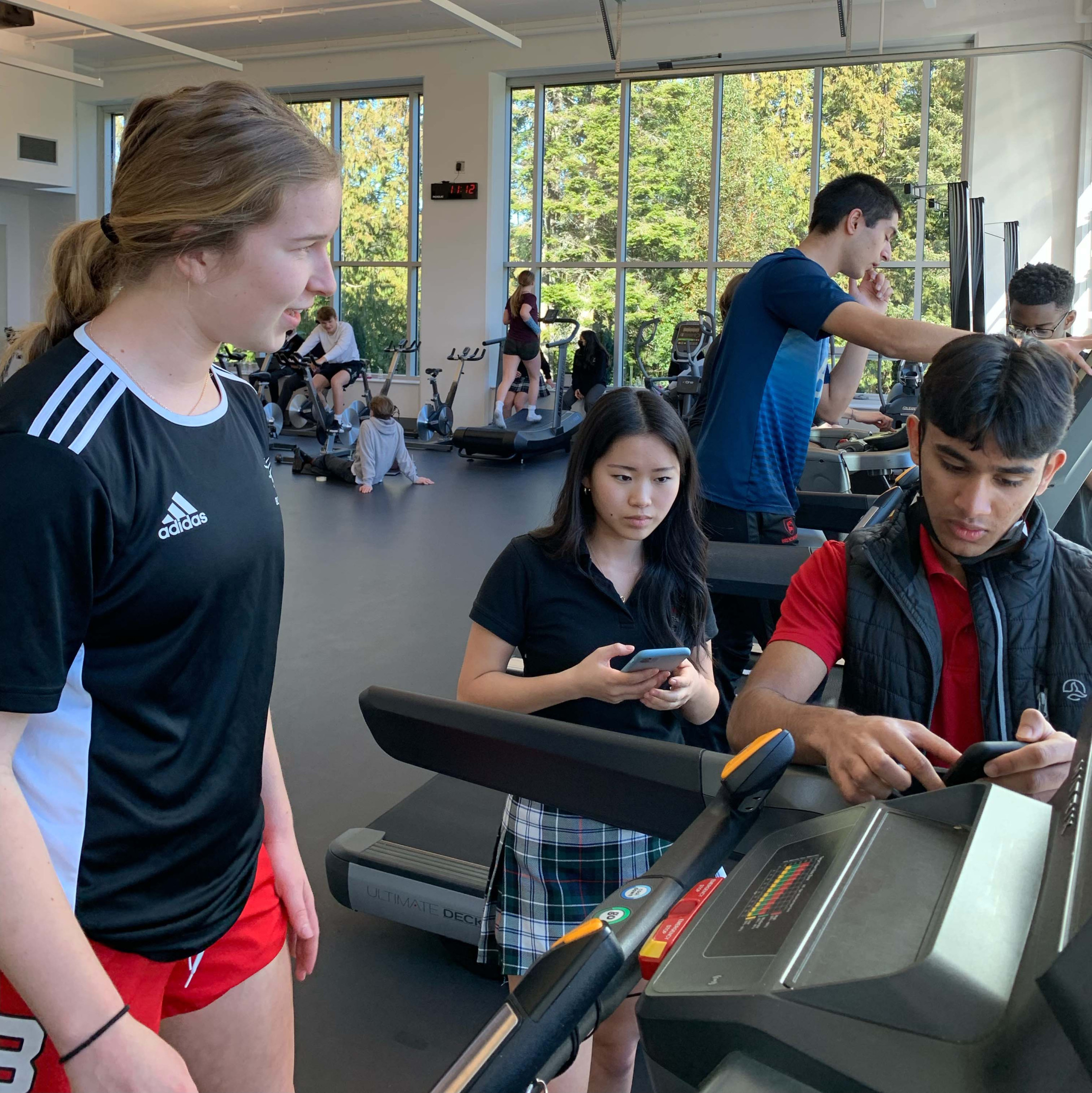
This past week biology teacher and Mack Houseparent Ms Sue Cheung put her 11 AP Bio students to a test. A test of knowledge? Not so much. More of a test of Grit, a test of Joy, a test of resilience, a test to see the correlation between resting, light, medium, and intense physical activity and the amount of CO2 produced by each student-athlete.
Students were separated into groups of two or three and told to BYOR (bring your own runners). We were given the choice to perish on a treadmill, erg, or stationary bike. Ty D, Whittall ‘23 – and the rower inside him – opted for the unpopular erg and the opportunity to “train for a new and improved 2K time”, Declan G, Julian E, and Ian C peddled to the test, and Jai S, Liv S and I led our groups to victory on the treadmill.
The lab was simple – well not really, unless you are in AP Bio 11– students were to blow through a straw, into a beaker of water containing 5 drops of 0.1M NaOH (sodium hydroxide) and 5 drops of phenolphthalein. Big words, I know. Big breaths too.
However, unlike my clickbait title may imply, the objective was not to blow more bubbles than the rest of the class. Our hypothesis was that as exercise and heart rate increased, the time in which it took us to turn the pink solution white (by adding CO2) would decrease because we would be exhaling more CO2.
Now, next time you think of complaining to your child about why their Bio mark is suboptical, ask yourself if you could memorize acids, bases, subatomic particles, glycolysis, prokaryotic and eukaryotic cells, because they can – or at least they should be able to. But not today, today there are no books, today we run (or bike, or erg) free.
Jensa NG, Mack ‘23


Where Students Choose To Be
+1 (250) 743-5521
admissions@brentwood.ca
info@brentwood.ca
2735 Mount Baker Road
Mill Bay, BC, Canada V8H 1K8