
Advanced Placement Courses
Brentwood’s versatile timetable allows students at any grade level to take advantage of the many Advanced Placement (AP) options offered at the School.
These courses are designed by the US-based College Board and provide a curriculum equivalent to first-year university-level courses. Over 1,000 post-secondary institutions in the USA and Canada regularly grant advanced placement into a second-year course, or first-year course credit, to students achieving AP examination results of 4 or higher.
The exam associated with each course occurs in the first two weeks of May and students commit to writing the exam by enrolling in the course. In the case of biology and chemistry, students begin their journey to AP at the Grade 11 level and complete the course in Grade 12.
AP Biology 11
This course covers key topics that explain the structure, function, and continuity of life. Students explore biomolecules and how they form the foundation of living organisms; examine cell structures and functions, with a focus on membranes and the movement of materials across them; and study the principles of evolution and natural selection. The course also investigates DNA as the blueprint of living organisms, the stages of the cell cycle, and the mechanisms of heredity. In addition, students are introduced to biotechnology and its applications in modern science. This course is the first half of what is equivalent to a first-year university course, and so there is a large amount of content and ability to synthesize the material. Notes, readings, labs, activities, and projects are all involved with this course.
AP Biology 12
This course focuses on the core principles that explain how living systems function and interact. Students examine how evolution drives both the diversity and unity of life, and how biological systems use energy and molecular building blocks to grow, reproduce, and maintain dynamic homeostasis. The course also explores how living systems store, retrieve, transmit, and respond to information essential to life processes, and how interactions within and between biological systems give rise to complex and interconnected properties. There is an emphasis on hands-on activities, such as experiments, projects, and fieldwork, to develop science skills and thinking. Students will write the AP Biology exam in May.
AP Biology 11 and 12 cover overlapping material; the course also incorporates Anatomy & Physiology 12 topics, allowing students to earn both credits by the end of the year.
Course Prerequisite: AP Biology 11
AP Calculus AB 12
AP Calculus AB emphasizes a deep understanding of fundamental calculus concepts while providing students with experience in a variety of methods and real-world applications. Students are expected to use definitions and theorems to construct logical arguments and justify their conclusions. The course adopts a multi-representational approach, exploring calculus concepts and problems through graphical, numerical, analytical, and verbal perspectives. Clear and precise communication of methods, reasoning, justifications, and conclusions is a central focus throughout the course. AP Calculus AB is designed to be equivalent to a first-semester college calculus course and concentrates on differential and integral calculus. Topics include limits, continuity, differentiation and its applications, integration, differential equations, and applications of integration. Students will write the AP Calculus AB exam in May.
Course Prerequisite: Pre-Calculus 12 completed (recommended) or concurrent
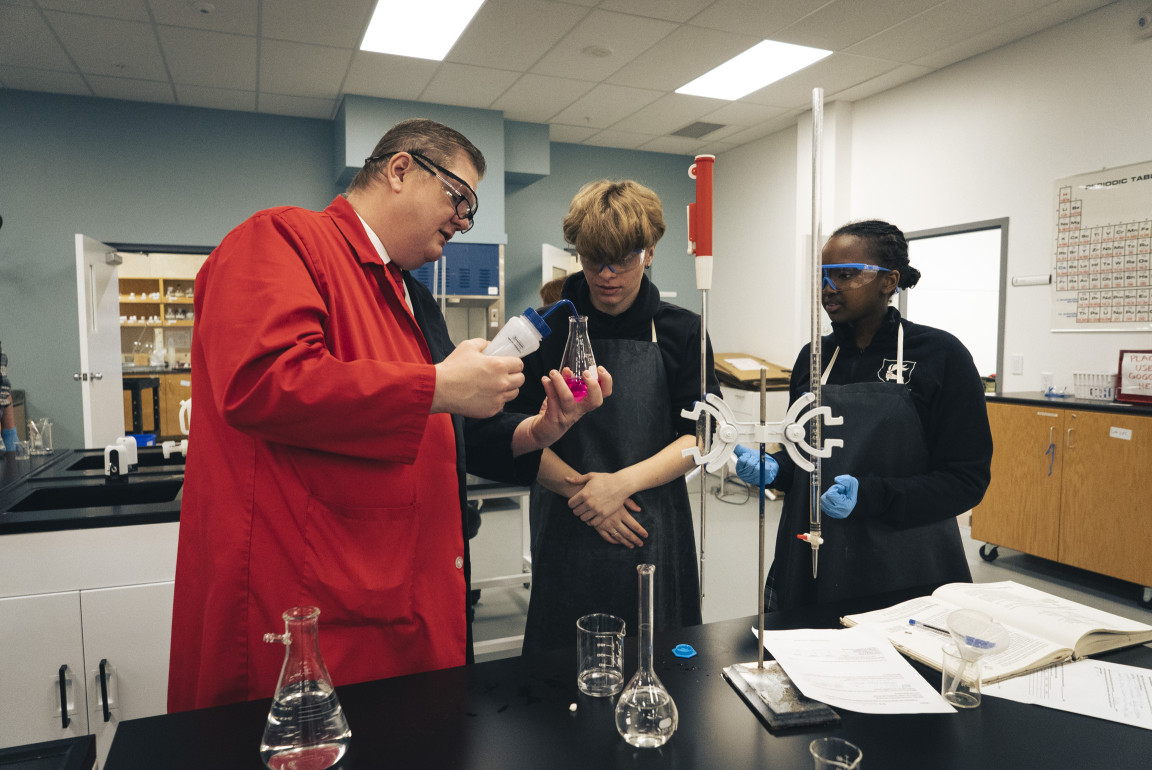
AP Chemistry 11
This course covers key topics that explain the structure, function, and continuity of life. Students explore biomolecules and how they form the foundation of living organisms; examine cell structures and functions, with a focus on membranes and the movement of materials across them; and study the principles of evolution and natural selection. The course also investigates DNA as the blueprint of living organisms, the stages of the cell cycle, and the mechanisms of heredity. In addition, students are introduced to biotechnology and its applications in modern science. This course extends beyond the topics covered in Chemistry 11 and is fast-paced, requiring some independent study.
Course Prerequisite: Proficient in Science 10 and Math 10 is highly recommended
AP Chemistry 12
In addition to the units covered in Chemistry 12, the AP course adds Thermodynamics and Applications of Thermodynamics. AP is faster-paced than regular Chemistry 12 and adds complexity in some units. Students will engage in problem-solving for open-ended theory, multiple-choice calculations, and guided inquiry investigations.
Solid algebra skills are essential: formulae, rearrangement of formulae, substitution of variables, and calculation with proper presentation skills on paper are employed regularly. Students will write the AP Chemistry exam in May.
Course Prerequisite: AP Chemistry 11. Proficient in that course is highly recommended.
AP Chinese Language & Culture 12
This course emphasizes communication (understanding and being understood by others) by applying interpersonal, interpretive, and presentational skills in real-life situations. This includes vocabulary usage, language control, communication strategies, and cultural awareness. The AP Chinese Language & Culture course is designed to develop students’ proficiencies in listening, speaking, reading, and writing in Mandarin. The course emphasizes communication in real-life contexts, fostering cultural understanding and appreciation through an exploration of Chinese traditions, practices, and contemporary society. To best facilitate the study of language and culture, the course is taught almost exclusively in Mandarin. Students will write the AP Chinese Language and Culture exam in May.
Course Prerequisite: Mandarin 12. Students without Mandarin 12 credits who wish to enroll must schedule an interview with Ms. Yang for consideration.
AP Comparative Government & Politics 12
Through the lens of six countries (the United Kingdom, Nigeria, China, Russia, Iran, and Mexico), students will explore the questions of: Who has power? Why? How do they wield it? Is it democratic? How is that assessed? What structures are in place to hold or share power?. This course will help students better understand global political questions and ensure they are informed citizens of the world who can apply a critical perspective to political issues. The most important quality students can bring is a profound interest in politics and governance. Much of the course is discussion-based: seminars, current events discussions, presentations, and guest speakers. Students will write the AP Comparative Government and Politics exam in May.
AP Computer Science A 12
AP Computer Science A is an in-depth study of the Java computer language. The students will learn the basics of object-oriented programming and build a foundation in programming that will prepare them for any post-secondary discipline. Units of study include: control structures; classes and objects; interfaces; arrays; array lists; inheritance and classes; streams and files; recursion; binary search tree, analysis of algorithms and sorting methods. Designed to provide practical coding and problem-solving skills, the course serves as a foundation for future studies or careers in computer science and computer engineering. Prior coding experience is highly recommended. Students will write the AP Computer Science A exam in May.
AP Computer Science Principles 12
AP Computer Science Principles is an entry-level course that introduces students to the foundations of modern computing. The curriculum does not assume prior knowledge of computing concepts, though knowledge of introductory algebra is assumed. The course covers a broad range of foundational topics, including programming, algorithms, the Internet, big data, digital privacy and security, and the societal impacts of computing. Major units of study include: digital information, the internet, introduction to algorithms and programming, big data: research and privacy, building apps, and creating and exploring tasks. Students will complete two in-class performance tasks and write the AP Computer Science Principles exam in May.
AP English 11
Students who elect to take the AP option will cover all the English 11 curriculum, most of which will be completed by March, plus write many timed, in-class synthesis, analysis, and argument papers. Students, in fact, are assessed and receive credit for both courses.
Students’ AP marks will be based on the AP-specific work she does―predominantly in the spring―in preparation for the College Board paper.
This is an accelerated environment recommended for students who were consistently proficient or extending in English 10 competencies and who are willing to read and write about unfamiliar texts under timed conditions.
Kids who struggle to meet deadlines should stay away. It requires more reading and much more critical writing than English 11, but it is also the bee’s knees and the cat’s pyjamas.
AP Environmental Science 12
This course focuses on the fundamental ideas that shape ecological and environmental systems. Students examine how energy transfer and conversion underlie all ecological processes and how Earth functions as one interconnected system whose natural and biogeochemical processes change over time and space and vary in their ability to recover from disturbances. The course also explores interactions among different species and their environments, with particular attention to how humans have altered natural systems over millions of years. Emphasis is placed on sustainability and on developing practices that support the long-term survival of both human societies and natural systems. Students have the opportunity to develop critical and scientific thinking skills and explore a wide range of interconnected topics. The course helps build a framework of knowledge and concepts that provides a basis for examining complex ideas. Students will write the AP Environmental Science exam in May.
AP French Language 12
The AP French Language and Culture course emphasizes communication (understanding and being understood by others) by applying interpersonal, interpretive, and presentational skills in real-life situations. This interactive class allows students to develop language skills and learn about a variety of topics related to the francophone culture. Learning activities include listening and reading comprehension, writing and oral communication tasks, and novel studies that support language development. Throughout the course, students also analyze a variety of authentic audiovisual resources to strengthen their understanding of real-world language use. Students will write the AP French Language and Culture exam in May.
Course Prerequisite: Recommended for students who have completed Immersion French and new students with significant immersion or francophone background.
AP Macroeconomics 12
This college-level course introduces students to the principles that apply to an economic system as a whole. The course places particular emphasis on the study of national income and price-level determination. It also develops students’ familiarity with economic performance measures, the financial sector, stabilization policies, economic growth, and international economics. Students learn to use graphs, charts, and data to analyze, describe, and explain economic concepts. Students will explore concepts such as GDP, inflation, interest rates, unemployment rates, fiscal and monetary policies, foreign exchange and bonds, and, most importantly, how these factors impact everyday life. Students will write the AP Macroeconomics exam in May.
AP Microeconomics 12
AP Microeconomics is a college-level course that introduces students to the principles of economics that apply to the functions of individual economic decision-makers. The course also develops students’ familiarity with the operation of product and factor markets, distributions of income, market failure, and the role of government in promoting greater efficiency and equity in the economy. Students learn to use graphs, charts, and data to analyze, describe, and explain economic concepts. Students will write the AP Microeconomics exam in May.
AP Physics 11
The AP version of this course is very different from Physics 11 and explores physics concepts in greater depth and mathematical rigour. Students study kinematics, focusing on how an object’s motion can be described, analyzed, and predicted; dynamics, examining the forces involved in one-dimensional, two-dimensional, circular, and rotational motion; statics; and fluid mechanics. The course also covers work and energy, as well as momentum and impulse, providing a comprehensive foundation in advanced mechanics. This is a fast-paced, rigorous course in which students will continuously engage in problem-solving and experimental design, stretching their mathematical skills. Graphical analysis is a critical component of the work in this course. Students will write the AP Physics 1 exam in May.
Course Prerequisite: Pre-Calculus 11 completed (recommended) or concurrent is required.
AP Physics 12
AP Physics 12 builds on the work in AP Physics 11 and continues to focus on concepts involving forces and fields, energy conservation, and systems of particles. These concepts are reflected in the study of thermodynamics, electrostatics, circuits, electromagnetism, waves, optics, rotational motion, and modern physics. Problem-solving, both individually and in groups, is a large part of the course. Students should enjoy exploring physical phenomena, apply their mathematical skills to that understanding, and engage with others to ensure they can articulate their knowledge effectively. Students must be more than comfortable with their math skills, as they will be employed daily and assumed to be highly proficient. Students will write the AP Physics 2 exam in May.
Course Prerequisite: AP Physics 11
AP Psychology 12
This course introduces students to the systematic and scientific study of human behaviour and mental processes. While considering the studies that have shaped the field, students explore and apply psychological theories, key concepts, and phenomena associated with major units of study, including biological bases of behaviour, cognition, development, learning, social psychology, personality, and mental and physical health. Throughout the course, students apply psychological concepts and employ psychological research methods and data interpretation to evaluate claims, consider evidence, and communicate ideas effectively. Students will write the AP Psychology exam in May.
AP Research 12
This course prepares students to conduct original research in any discipline at the university level. Students design, plan, and implement a year-long investigation to address a research question. Through this inquiry, they further the skills they acquired in the AP Seminar course by learning research methodology, employing ethical research practices, and accessing, analyzing, and synthesizing information. The course culminates in an academic paper of 4,000–5,000 words (accompanied by a performance, exhibit, or product where applicable) and a presentation with an oral defence.
Course Prerequisite: AP Seminar 11 with at least an AP score of 3.
AP Seminar 11
This course is aimed at building and refining high-level reading, thinking, discussion and research skills. It explores contemporary issues and provides students with a framework for pursuing academically rigorous research in an area of personal interest. Students will explore their chosen themes through collaborative discussions and in-depth research papers, building a foundation for critical analysis. They will further refine their communication skills by mastering persuasive writing and practicing public speaking. This course is best suited for students with solid foundations in close reading and scholarly writing who want to lean into big research projects and who are passionate about exploring real-world issues across all subjects. Students will write the AP Seminar exam in May.
AP Spanish Language 12
The AP Spanish Language course emphasizes communication (understanding and being understood by others) by applying interpersonal, interpretive, and presentational skills in real-life situations. This interactive class allows students to develop all of their language skills and learn about a variety of topics related to the Hispanic culture. Learning activities include listening and reading comprehension, writing and oral communication tasks, and novel studies that support language development. Throughout the course, students also analyze a variety of authentic audiovisual resources to strengthen their understanding of real-world language use. Students will write the AP Spanish Language and Culture exam in May.
Course Prerequisite: Recommended for current students who have completed Spanish 12, those with significant Spanish immersion experience, and native speakers.
AP Studio Art 11
This course presents students with the challenge of researching, defining, producing, assessing, refining and reflecting a body of work in the fields of art and/or design.
This course is studio-based, with time spent in active, self-guided studio work during both the academic (morning) class time and an art afternoon commitment (beyond regular Brentwood Arts requirements). Instruction consists of broadly defined assignments, individual coaching, and guided group critique. Additional instruction is occasionally provided to provide exemplars from the worlds of art and design, outline technical issues related to art-making or curatorial practice, or to discuss post-secondary paths and career opportunities related to art and design.
AP Studio Art 12 has a final AP exam that takes the form of an adjudicated portfolio submission. Students are not required to make the submission while in AP Studio Art 11; those students are typically on track to spend a second year in AP Studio Art 12 in Grade 12 and submit that portfolio then. If students start in Grade 11 in this course, they should note that Ministry credit is only awarded at the end of their second year in the course with the completion of the AP portfolio submission.
Students should only take this class if they are passionate about making, feel comfortable in a studio environment and are capable of self-directed, inquiry-based learning. Students should be prepared to find time in their schedules for several hours per week of independent studio work above and beyond the time commitments already listed. It will be very challenging to find success in this course without a strong routine.
Course Prerequisite: Application, portfolio submission, and interview with course instructor, Ms. Andersen.
AP Studio Art 12
This course presents students with the challenge of researching, defining, producing, assessing, refining and reflecting a body of work in the fields of art and/or design.
This course is studio-based, with time spent in active, self-guided studio work during both the academic (morning) class time and an art afternoon commitment (beyond regular Brentwood Arts requirements). Instruction consists of broadly defined assignments, individual coaching, and guided group critique. Additional instruction is occasionally provided to provide exemplars from the worlds of art and design, outline technical issues related to art-making or curatorial practice, or to discuss post-secondary paths and career opportunities related to art and design. The final AP exam for this course takes the form of an adjudicated portfolio submission; however, students who are permitted to take the course in Grade 11 typically are on track to spend a second year in the course in Grade 12 and submit that portfolio then. If students start in Grade 11 in this course, they should note that Ministry credit is only awarded at the end of their second year in the course with the completion of the AP portfolio submission.
Students should only take this class if they are passionate about making, feel comfortable in a studio environment and are capable of self-directed, inquiry-based learning. Students should be prepared to find time in their schedules for several hours per week of independent studio work above and beyond the time commitments already listed. It will be very challenging to find success in this course without a strong routine.
-
Course Prerequisite: Application, portfolio submission, and interview with course instructor, , Ms. Andersen, or completion of AP Studio Art 11
AP World History 12
In AP World History: Modern, students investigate significant events, individuals, developments, and processes from 1200 to the present. Students develop and use the same skills, practices, and methods historians employ: analyzing primary and secondary sources; developing historical arguments; making historical connections; and reasoning about comparison, causation, and continuity and change over time. The course explores six themes to connect historical developments across different times and places: humans and the environment; cultural developments and interactions; governance; economic systems; social interactions and organization; and technology and innovation. Students will write the AP World History Modern exam in May.
Course Prerequisite: It is recommended, though not required, that students complete a regular senior social studies course before taking this course.


Where Students Choose To Be
+1 (250) 743-5521
admissions@brentwood.ca
info@brentwood.ca
2735 Mount Baker Road
Mill Bay, BC, Canada V8H 1K8