
Clam Garden Restoration Project
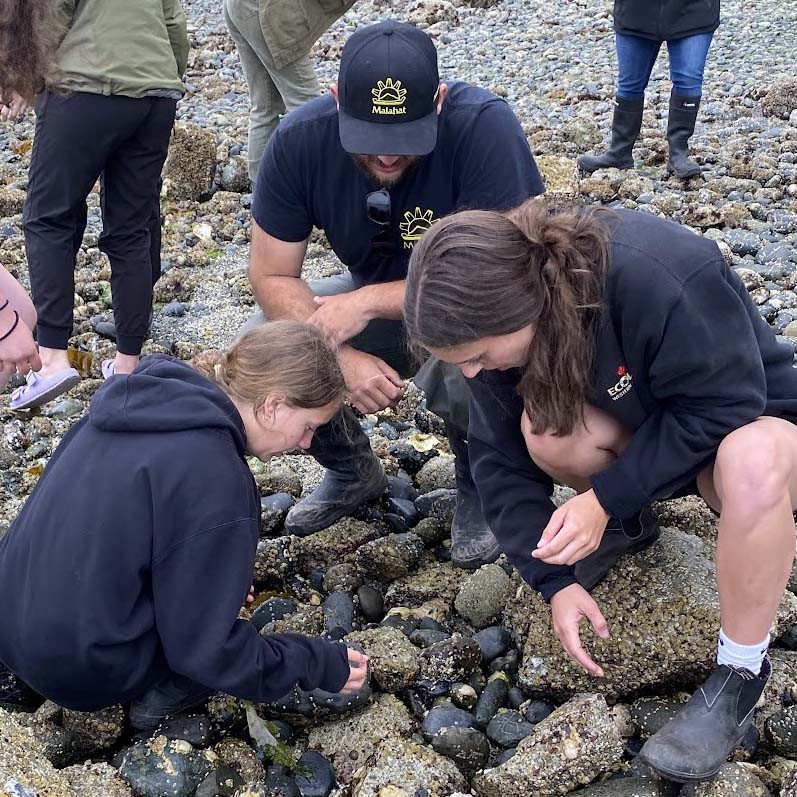
On Tuesday, May 23rd, a group of students from our rowing program volunteered to join members of the Malahat Nation’s Environmental Team to work on a project designed to restore a historic clam garden located on the shore. Students completed their morning training session and then came ready to move rocks, count sea life, and observe biodiversity.
The rowers had passed this section of beach countless times in their training on the water and hadn’t noticed a perfectly placed ancient rock wall, constructed to protect the shore behind it so that clams could safely reproduce and grow for harvesting. This vital food source has dwindled as the ancient knowledge and practice of maintaining clam gardens fell away because lands were taken and Indigenous practices were restricted. Indigenous communities are eager to restore these important cultural sites.
We began by exploring the section of the beach and were encouraged to notice sea life. Luckily, Ben, a marine biologist, was on hand to answer all of our questions as we looked to identify what we were seeing. After a quick lunch on the beach, Brentwood students were fortunate to be invited to learn from experts and participate in three different activities.
One was to work with Ben and track what we could identify for sea life in a section of the shore. We had lists of types of plants and organisms and when we saw it, we marked it on the sheet. Crabs, oysters, starfish (sea stars), graylings, varieties of seaweed – the shore was alive with activity.
A second activity was to place a quadrat marker, remove all rocks within its limits, and set them to the side and then count the clams that were found in the quadrat. The clams were divided into three categories; live, dead and dead assemblage (where the ‘hinge’ was intact for the two shells). Digging into the sand and counting the number of clams that were alive compared to dead helped us to see the importance of the work in restoring the garden. The quadrats had three to seven live clams and usually more than 60 that were dead. The third station was rock removal. In order to provide the best environment for the clams, overlying rocks need to be removed so that oxygen is available for the clams in the sand. Using pails and a wagon, rocks from larger to quite small were removed from a section of the bed. This is the type of work that needs to continue in order to restore the habitat.
At the end of the afternoon, we were introduced to John Harper, a renowned researcher on the topic of Indigenous clam beds. He was able to recount the discovery of clam beds from aerial surveillance being done for something unrelated on the West Coast, which then led to more elders sharing their stories about community practices related to coming together in these special spaces. Noticing rock walls all along the coast piqued his interest and curiosity which then became his life work. [Links to more information on clam bed and clam bed restoration are included at the end of this article.]
Sitting in a circle on the beach to end the day, students shared what they had learned or how they felt after being a part of this project. They appreciated being invited to participate and wished that they could have done more.
No one who participated will pass by this location without noticing the rock wall and wonder how the clams are doing.
Ms Cheryl Murtland, Deputy Head – Academics


Where Students Choose To Be
+1 (250) 743-5521
admissions@brentwood.ca
info@brentwood.ca
2735 Mount Baker Road
Mill Bay, BC, Canada V8H 1K8