
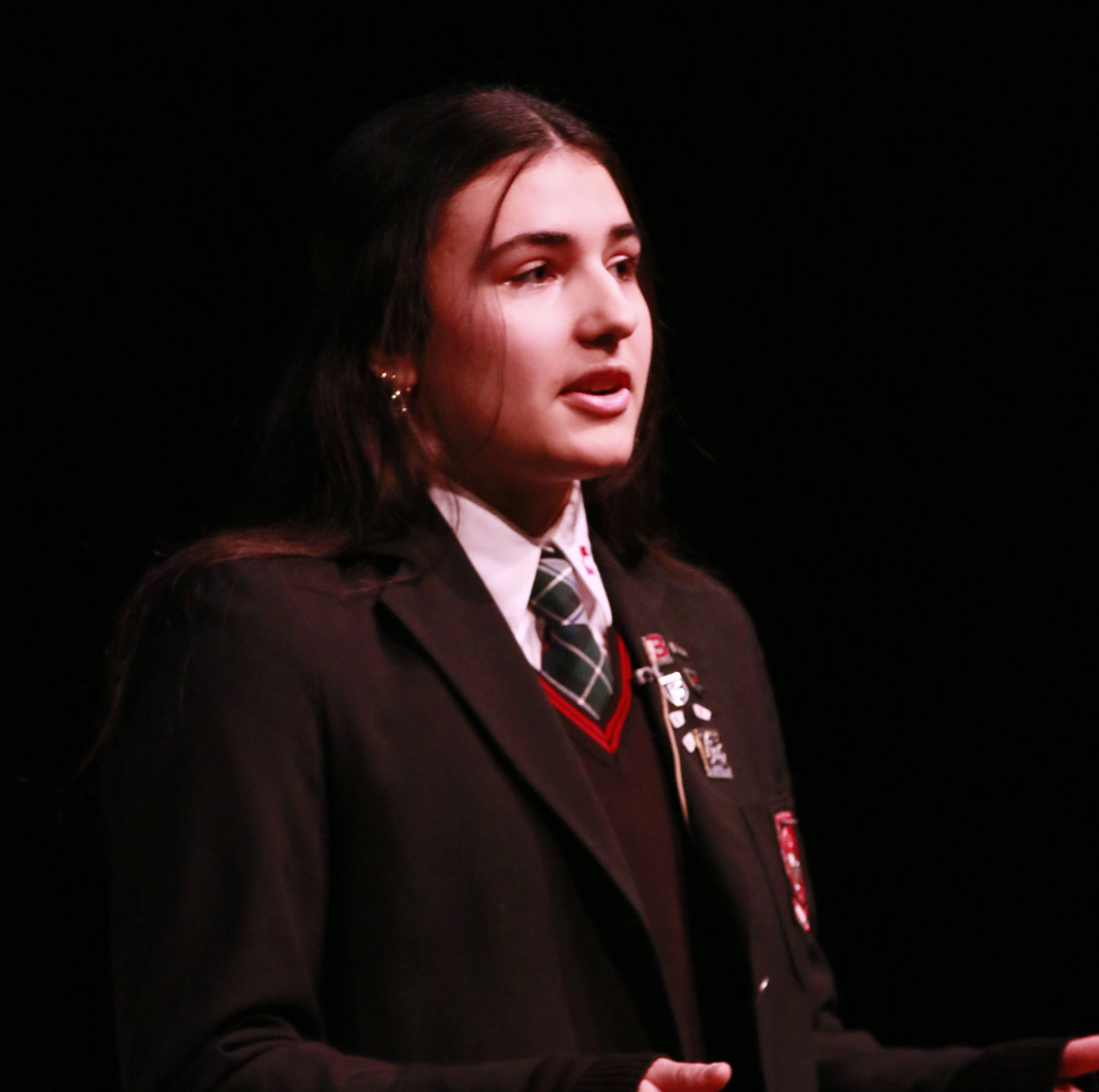
Period Poverty – A Melhuish Speech
This Melhuish Public Speaking Competition winner was delivered at Assembly on Thursday, February 2nd. “It must be her time of the month.” “She’s PMSing, ignore her.”
These are common, mainstream portrayals of a woman or individual who menstruates. In less fancy words, that means when one gets their period. A period, or a menstrual cycle, is a coming-of-age passage for young women or anyone with ovaries and a uterus. It consists of one bleeding-out continuously for 3–8 days, once a month, from as early as 10 years old to as late as 51 years old. That’s 41 years of bleeding 12 times a year.
What is a beautiful and healthy rite of passage for young women and individuals with uteri everywhere has been abstracted by mainstream media and society as an embarrassing occurrence, a shameful experience to talk about, or a burden to accommodate. These consequential stigma, of a growing and developing human body, has led to the topic of my Melhuish today, period poverty.
The Borgen Project defines period poverty as the difficulty in affording menstrual products among many low-income women, girls, and individuals who bleed. What is, or should be, classified as a basic need, can cost up to $6,000 dollars in a lifetime. Lack of access to menstrual products worldwide, such as pads, tampons, and menstrual cups, has become a public health crisis, and a demolishment of the self-confidence for women and individuals who get their periods, but cannot afford to accommodate them. This needs to change.
“Who here gets their period?”
Let’s be honest with each other: by being able to attend this school, we are very privileged. We get the amenities others don’t and we are able to afford what many others can’t. Even so, period poverty is not beyond us; it still applies to every person in this room, even male houseparents, male staff, those who live in our male residences on campus, Privett, Whittall, Rogers, Ellis, even those who don’t get their period. You may not be worrying about those expenses for yourself today, but what happens when you get married, or you get a partner, or have kids, and they menstruate, and then that financial responsibility falls, in one way to another, to you?
Periods do not stop for pandemics, employment, or everyday life simply because one can’t accommodate it. More than 98 million girls worldwide miss out on their education due to lack of access to menstrual products. Not only that, but our peers, friends, and classmates deal with stigma and fear of embarrassment that they may bleed through clothing in class even though it is a natural, normal process. This is the reality for many students and all individuals who menstruate for that matter. 17 million people who menstruate in the US are living in poverty, and half in the past year have had to choose between food and product.
We should not put the menstruator at fault for not being able to afford or access the accommodations they need for their periods; it is the corporations that produce, distribute, and profit around the world, and the societies that shame the bodies we were born in. We need to ensure that every young girl, every woman, every individual does not grow up with the stigma and inaccessibility that comes with a normal and healthy process of the human body. You may not menstruate yourself, but I’m willing to bet that a parent, a friend, a colleague, or someone you love gets their period. More than half of the world’s population are menstruating people, and it is high time that period poverty becomes everybody’s business.
Florence T, Hope ‘24


Where Students Choose To Be
+1 (250) 743-5521
admissions@brentwood.ca
info@brentwood.ca
2735 Mount Baker Road
Mill Bay, BC, Canada V8H 1K8