

The Changing Face of December Exams
Having midyear exams is far from the norm at most schools, even those that aspire to the highest academic standards. The loss of teaching time, stress at the end of a long term, and disruption to the regular routine are quoted as reasons why these exams are best discarded. In recent years we at Brentwood have debated the advisability of the December tests, tried January exams instead, and considered just having June finals.
Overall, we currently believe that a cumulative test at this time gives the vast majority of students an opportunity to knit together the term’s work and to showcase their knowledge after absorbing, processing and rehearsing the concepts and content throughout the term. It also gives the student an opportunity to experience a large exam setting in preparation for June finals and practice the various facets of exam taking that are still important factors in university success. Teachers have the chance to review exam technique in December and critique students’ exam work with them in January. Many students like the more relaxed exam routine and the sense of closure on the term as well as a chance to consolidate the various topics they have studied.
Nevertheless, we continue to be mindful of other ways of assessing student understanding and how rewarding these alternative forms of exam can be. The language department this year decided, for example, to have students take an in-class summative test and then work on a ‘webquest’ project which they presented as a final assignment. Students were able to get creative and use IT as well as communication skills to illustrate aspects of language and culture.
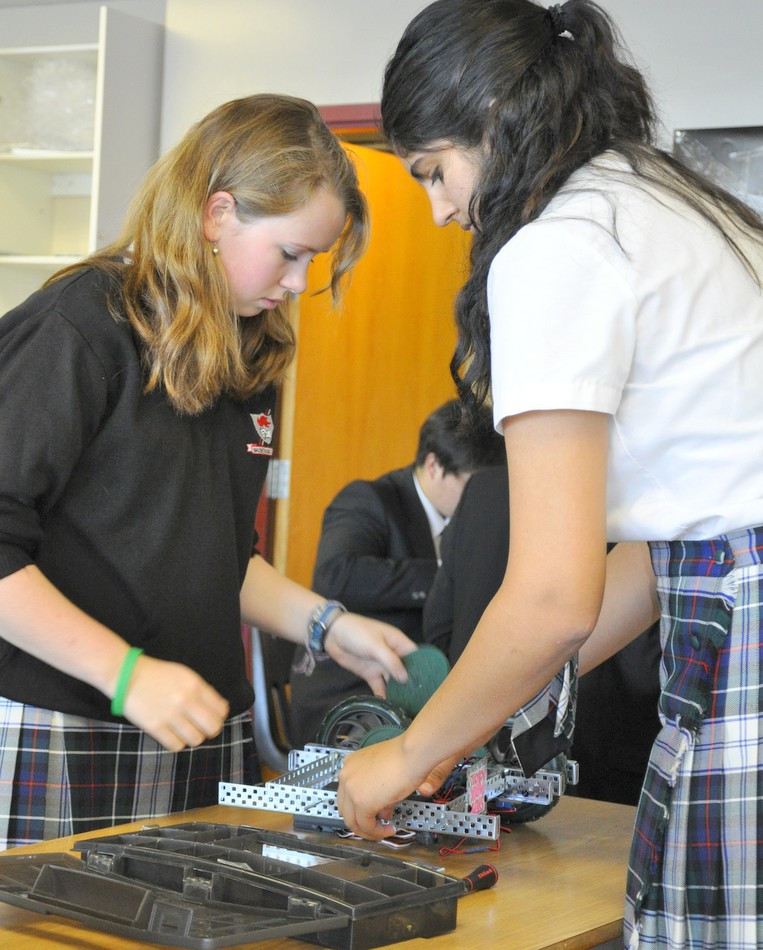
In our Robotics 11 elective course, Mr. Wardrop designed a “challenge” where students had to work in groups to design a robot (in two hours) that could complete the task of moving up a ramp, remove a lid from a bucket, scoop up table tennis balls and retrieve them back down to ground level. Students worked in groups of three with assigned roles and went through a creative brainstorming, design and planning process which was then handed in for marks. Meanwhile, the exam rubric that they received the night before gave them clear guidelines on how to score highly on the exam in terms of their respective roles and work as members of a team.
More than ever we accommodated teachers’ desires to have exams on-line with the Mr. Collis and English department taking the lead here and posting their tests on the department’s Moodle page (just prior to the start, of course) where students in the exam centre accessed them via the wireless network on their own laptops.
As Director of Academics I applaud these initiatives and a move to a wider spectrum of assessment modes. A healthy mix of traditional and 21st century exam methods is perhaps what is called for to best equip our students for university and beyond. As always, I welcome your comments and feedback as parents and alumni.
Mr. David McCarthy, Director of Academics


Where Students Choose To Be
+1 (250) 743-5521
admissions@brentwood.ca
info@brentwood.ca
2735 Mount Baker Road
Mill Bay, BC, Canada V8H 1K8