
Academic Strategic Planning
This fall, a group of Brentwood teachers will be brainstorming and researching as a “task force” team, established with the ultimate aim of formulating the academic goals of Brentwood’s strategic plan. Much of the work will involve an external scan of best practices in education in other schools across North America and the trends in education globally. As we embark on this process, I invite blog readers to contribute their thoughts on such questions as
What is the role of technology in education?
How far do we go to facilitate the concept of “personalized” learning?
What is the balance between “sage on the stage” pedagogy and “guide on the side”?
What are the essential skills and competencies that Brentwood students should graduate with and what do they need for success in the changing landscape of post-secondary learning and the workplace?
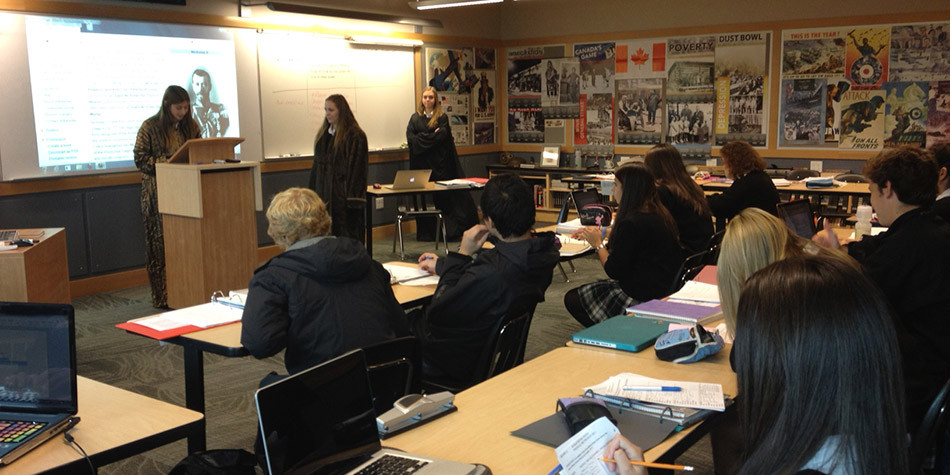
We are fortunate to have a diverse group of excellent faculty at Brentwood who demonstrate a wide variety of teaching styles and facilitate learning in creative ways. Nevertheless, we cannot afford to become complacent or ignore the tectonic movements shaking educational institutions today. Rather, we must look at what is the optimal blend of teaching and learning styles to meet the needs of our students and, most importantly nurture a growth mindset that fuels their appetite for learning as a life-long passion. The picture that accompanies this entry shows Mr Steve Cowie’s History 12 students delving into the causes of the Russian Revolution. Students work in groups to represent various factions such as the monarchists, Bolsheviks and so on. After researching their positions, they present their arguments to the class (some in costume!) while the other students take notes and decide who has developed the most persuasive argument. Embedded in this exercise are key skills such as gathering information collaboratively, analyzing a position, developing and rebutting an argument, and public speaking. Such a class is not unusual at Brentwood; in fact, I wandered into the class just yesterday and thought it was a great example of an interactive lesson in a dynamic learning environment. In the new Visual Arts classrooms, students are able to connect their laptops wirelessly to the projectors to make sharing of information even easier. As you can see from the photograph, this is not replacing the poster board approach, but adding a dimension that is even more engaging. I look forward to your comments and suggestions as our committee gets going in the weeks ahead.


Where Students Choose To Be
+1 (250) 743-5521
admissions@brentwood.ca
info@brentwood.ca
2735 Mount Baker Road
Mill Bay, BC, Canada V8H 1K8