
In Remembrance
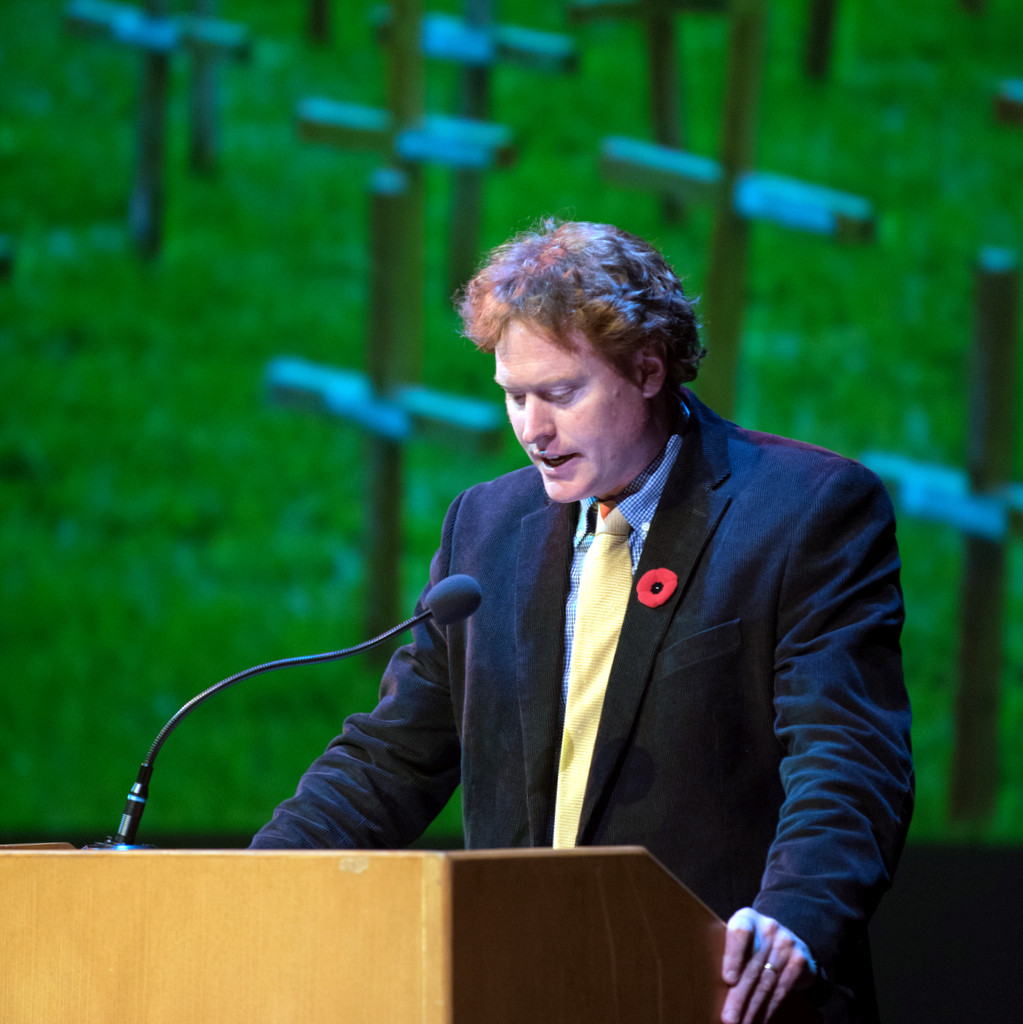
The following address was delivered by Mr. Shem Fitzgerald, Social Studies teacher, rowing coach, and Ellis Assistant Houseparent, who has joined Brentwood this year on exchange from Geelong Grammar School in Australia.
From the outset, I want to say that it is a great honour to be asked to speak to you today.
I certainly don’t take this honour lightly, as I am a guest in your country and school. We actually have two days back home when we stop and reflect on the devastation of war. One is Anzac Day – the 25th of April and the other, Remembrance Day, the 11th of November. Both are treated with great reverence.
Our participation in conflicts around the globe over the last 100 years has had a profound effect on shaping our identity as a nation – an identity of which we are monumentally proud.
I feel very fortunate that the devastation of war has not touched me personally. However, I stand here and proudly tell you that two of my great-grandfathers fought on the Western Front in the 1st World War and my grandfather fought the Japanese in WWII. I am, like most Australians and Canadians, proud of our countries’ involvement in global conflicts so far from home.
It is an intriguing conundrum. There is nothing glorious about war; there is nothing good about what these men and women had to do. But still there is such ferocity to the feelings of national pride, respect, and reverence with which these heroes are remembered. I think of the character these men and women displayed, their bravery, courage, sacrifice, mateship, and determination.
In Australia, storytelling is an important part of the process of remembrance; tales shared from one generation to the next shape our perceptions of what it was and is to be an Australian Soldier.
Australian soldiers are affectionately called ANZACs or diggers. The slang term ‘digger’ relates to the trench digging duties during the world wars, and ANZAC is the abbreviation of the joint Australian and New Zealand Army Corps that formed part of the force that landed at Gallipoli in 1915.
War provided the fledgling nation of Australia the opportunity to define itself as different and unique from the British Empire. In each of the wars, Australian forces have been categorized by others through their actions, and have become known as some of the fiercest, most courageous soldiers in the world. However, there is a catch. Australians also showed themselves to be the least disciplined, least respectful of authority, and most mischievous soldiers the Allies had ever known. As an example, the Sphinx in Egypt lost its nose as a result of Australian soldiers’ rifle practice in World War 1. The Australian soldier, the typical digger, was known to be a heavy drinker, brawler, and womaniser, who managed to fight a war in his spare time.
Anzac Day and Remembrance Day ensure that the heroic and mischievous deeds of Australian soldiers are recounted, and that their sacrifices are remembered by both young and old. This is a responsibility Australians certainly take seriously. Last year over 120,000 people attended the official Dawn Service at Melbourne’s war memorial, the Shrine of Remembrance, and each year millions attend similar dawn services in communities both big and small across the country.
I would like to give you a little insight into Australia’s most famous campaign. Most Australian historians agree that the eight month Gallipoli campaign during World War I played a crucial role in the formation of the Australian identity, a county formed through the federation of six British colonies just 15 years earlier. Interestingly, this defining event was actually one of complete devastation, disaster, and ultimate loss.
The ANZACs landed on the Gallipoli Peninsula as part of a combined English, French and Indian Army force. The plan conceived by Winston Churchill was to capture the Gallipoli Peninsula in order to control a narrow strait of water known as ‘the Dardanelles’. Winning the ‘Dardanelles’ would allow the Allied navies to control an important 67 kilometre stretch of coastline and give naval access to the British ally, Russia.
On the 25th of April 1915, the ANZAC soldiers were landed at the wrong location. They stormed a beach on the Gallipoli peninsula to be met by an awaiting Turkish army perfectly positioned at the top of impossibly high cliffs. The wrong location meant the task set for the ANZACS was next to impossible. Gains made were measured in meters and the soldiers sent up out of the trenches to try to advance the cause were being sentenced to almost certain death. Australia lost nearly 12,000 young men on this tiny piece of land by the time the British decided to allow the troops to retreat, and the ANZACS left Gallipoli eight months later with nothing but the death toll to show.
However, it is the stories of mateship and courage that form the fabric of our remembrance, and I would like to share just two. One story that every child in Australia is taught about is that of an ANZAC named Simpson, and his donkey.
Private John Simpson’s legend was not born out of taking up arms, storming the trenches and slaying the enemy. He is remembered for his remarkable bravery and sacrifice in saving his wounded mates in extremely trying conditions. Day after day he went to the front with his donkey to pick up the wounded soldiers. Even when he was told by his superiors not to risk his life, he still went, because he just could not stand to leave wounded soldiers on the battlefield stranded and dying. He was killed barely a month after he arrived on the peninsula, but his legend lives on in Australia.
From the 2nd World War we are all told of a group of Australian soldiers who fought in Libya and earned themselves a formidable reputation for being unbeaten, despite their perceived unwinnable circumstances. They are remembered in Australia as The Rats of Tobruk. The Australian soldiers gave themselves this nickname after Radio Berlin described the situation that the 9th Division of the Australian Infantry found themselves in as ‘caught like rats in a trap’.
For eight long months, surrounded by German and Italian forces, the men of the 9th Division in Tobruk withstood tank attacks, artillery barrages, and daily bombings. They endured the desert’s searing heat, the bitterly cold nights, as well as hellish dust storms and dwindling provisions. They lived in dug-outs, caves, and crevasses. The enemy could not believe that the defenders of Tobruk would not surrender, would not retreat. Their determination and bravery, combined with the aggressive tactics of their commanders, became a source of inspiration to the Allied forces and a source of immense frustration to the enemy.
So fierce a reputation did the Rats of Tobruk develop, that on one particular occasion a captured German officer, who had been told the feared Australian soldiers had left Tobruk, accused his captors of being British soldiers who had dressed up as Australians to scare the enemy into retreating.
The Rats of Tobruk became legends in Australia for never giving up, for continuing to fight when all others would have surrendered, and for winning when winning was meant to be impossible.
Now these are just two small stories of courage, mateship, and fighting spirit that define the Australian war efforts across the last 100 years.
When I was in school like you, I embraced Remembrance Day, and the stories told of remarkable acts by people that were older than me, and things that happened a long time ago.
When I was in my 20s I saw war differently. I then compared myself to the men and women in the stories. During this time I was fortunate, while travelling around the world for 18 months, to do what most young Australians dream of doing – visiting the battlefield at Gallipoli.
The night before I visited the actual sites of the battles at Gallipoli, I stayed in a youth hostel filled with New Zealanders and Australians. We were all there in Turkey for the same reason and we were all very fired up about the next day. We sat around recounting stories and watching the famous Australian movie called ‘Gallipoli’.
The next morning we headed off to the beach where the ANZAC’s landed. When I arrived on the beach and looked up at the cliffs the ANZACS had to scale, a feeling of sickness swept over me. All I could think of was that I was the same age as many of those soldiers, and would I have had the courage to jump out of the boat and run towards the cliffs with guns firing at me? I always knew these men were brave, but until I saw what they faced that day – the 25th April 1915 – I never realized just how brave they were.
I walked around the Gallipoli Peninsula and could clearly see some of the trenches the soldiers would have occupied nearly 100 years earlier, and in some cases the Allied and Turkish trenches are only metres apart. Could I have coped with the fact that I was only two metres from someone who wanted to shoot me dead? Would I have been able to climb up out of that trench when ordered and run to my certain death? I didn’t think I would, and this was a very sobering feeling indeed.
This now leads me to today, and I know my feeling of Remembrance Day is different than it was when I was a 15 year old school boy and as a 25 year old backpacking around the world. And that brings me to the photo behind me. This is a photo from the school I teach at back home, and every year on this day students place crosses in the grass next to the school’s War Memorial. Each cross represents a past student that gave his life for us. Behind the school’s War Memorial is an oak tree grown with an acorn seed brought home from the battlefield of Gallipoli by a Digger 100 years ago.
As a 40 year old, I have taught thousands of students in my 18 years of teaching. This day and these crosses serve to remind me that the fallen soldiers were once someone’s students – students just like you. I also see these crosses, and I see you my students, and I just hope and pray that we never add another cross.
We should be so proud that our forefathers and mothers gave of themselves so generously and bravely to help people so far away, so foreign, so unknown, for causes so removed from their own immediate lives. On this day each year as you move through life, I invite you, as a student, as a young adult, and as a parent or teacher, to celebrate the opportunity to remember with respect and reverence the great characteristics of human strength, generosity, sacrifice, and bravery shown by ordinary Australian and Canadian men and women for the freedom and quality of life that we enjoy today.
Mr. Shem Fitzgerald


Where Students Choose To Be
+1 (250) 743-5521
admissions@brentwood.ca
info@brentwood.ca
2735 Mount Baker Road
Mill Bay, BC, Canada V8H 1K8