
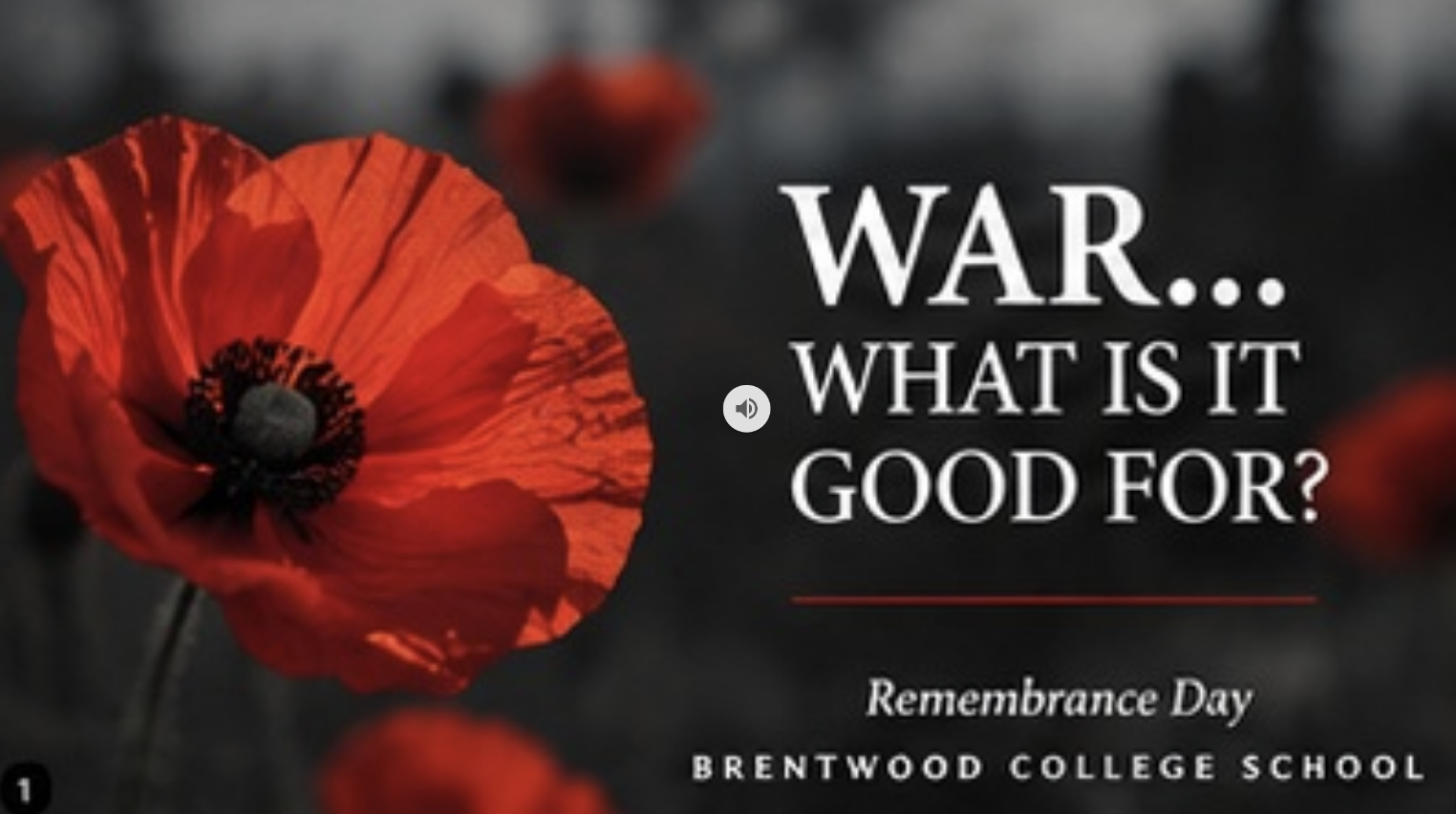
Remembrance Day
Below is the text of the address delivered by Ms Ivana Cappelletto at Brentwood’s Remembrance Day Ceremony last Thursday. Here is the accompanying slideshow.
“WAR! WHAT IS IT GOOD FOR? ABSOLUTELY NOTHING! SAY IT AGAIN!”
Some of you might recognize that song. It was made famous by Edwin Starr in 1970 during the Vietnam War. But today I want to ask you something: is it though? Is war good for absolutely nothing?
Of course, war brings unimaginable destruction, suffering and loss. But sometimes, out of that destruction, something extraordinary survives: courage, resistance, resilience, and the determination to never give up. Today I want to tell you about some unsung heroes of war. My family was one of those.
My story begins in northern Italy during the Second World War. Gavi is in Piedmont, northern Italy.
Gavi was the centre of our family’s story.
Italy was under Mussolini’s Fascist regime, and a resistance movement called the Partigiani was fighting against Fascism and Nazi occupation.
The Partigiani were a great many brave souls. They had to hide out, not to show their defiance and not to appear in public in protest, but rather to do all that was possible to try and overturn the Fascist regime that was partnering with the Nazis.
Gerolamo, my nonno’s Salvatore’s, older brother, is the medium guy on the left. When he turned 20, he joined the Partigiani.
One evening during a country barn dance, he turned off the lights and scattered resistance leaflets across the floor. A simple act of defiance. But someone betrayed him. Our next-door neighbour turned him in for the price of a chicken. With the fascists in power and war going on, food was scarce. He was my mamma’s brave uncle.
Gerolamo was arrested and tortured in front of his own mother, Nonna Carmelina. Despite everything, he refused to reveal the names of his fellow resistance fighters. He died in captivity.
He did not survive. But his courage did.
My grandfather Salvatore, younger brother of Gerolamo, had a very different experience: because of his brothers’ involvement in the resistance, he was forced to serve in Mussolini’s army or face execution.
Eventually, he was captured by American soldiers and sent to a prisoner-of-war camp in, of all places, San Louis Obispo, California.
Meanwhile, we have my Papa`s Nino, with my other nonno, Enzo. He was born in 1930, right before the chaos of war.
My father Nino’s smile was captured by my grandfathers’ skilled photographic talents.
My grandfather, Enzo, did not agree with the fascist regime, and the Partigiani were just starting to organize. He also got involved in the resistance. One day, men dressed in black came to his home. He put on his coat and hat and walked out the door.
My grandmother Nina and my father, baby Nino, who was just four years old, never saw him again.
Food was scarce. That winter they survived almost entirely on chestnuts gathered from the forest.
Near the end of the war, an air raid siren sounded: they were frequent and almost a common daily experience. My father ran ahead with his friends while his mother stopped briefly to speak to her best friend.
That day, an Allied bomb struck the building beside her. It collapsed. My father watched people desperately trying to rescue those trapped beneath the rubble, while retreating Nazi soldiers fired towards them. That day, my father became an orphan.
Then the tides were turning towards the end of the war. With his broken English, he explained to his American captors his family’s involvement with the Partigiani in the resistance. Being a skilled bricklayer, sculptor, and fabricator, while still officially a prisoner, he was eventually allowed to design and construct a monument honouring the Partigiani resistance at the camp.
Because of the Partigiani movement, the Italian forces were quickly abandoning the fascists and were fighting back against the Nazis. Salvatore never gave up. Even if his brother didn’t, he honoured the Partigiani Resistance fighters who survived.
Finally, people celebrated in the streets … children were biking in the square … soldiers finally were returning home. Families were reunited. But war does not always end when the fighting stops
Playing in the square, while everyone was rejoicing, Mino, my Uncle, my mom’s little brother and his best friend, Franco, found a hand grenade: it detonated. Mino was killed. His best friend was blinded for life.
The tragedy tore my mother’s family apart. Nonna Vanda was blamed for not watching him, even though she had been working and running errands in exchange for food. My grandma was driven away and found work in a factory. She survived.
That monument that Salvatore built still stands today. His craftsmanship survived.
My mother, Renza, was honoured to visit the site in 1986, and even corrected the naming of Italy Rock, as she still had the original newspaper clipping from 1945.
Salvatore’s skill and determination carried him through the war, and afterward, his ability to never give up and work hard made him a successful creator.
Today, Gerolamo’s name is engraved on a large memorial plaque on the outskirts of our hometown, Gavi, built by his brother, my grandpa Salvatore.
So, after the war ended, Nino, at fifteen, at the orphanage, learned the printing trade, operating enormous German-made printing presses. When he turned 18, his extended family couldn’t afford to house him, so he joined the military. The Alpini: mountain troops.
Then the 50s happened: a great industrial resurgence and prosperity and survival of the Italian democratic nation.
Meanwhile, my father, Nino, during his military service in the Italian Alpine troops, developed a love of skiing, mountaineering, paratrooping and, of course, photography: his father’s passion survived.
His new ‘family’, the Alpini, developed his skills for never giving up, working hard and surviving.
His competitive nature benefited his spirit: competition makes one first work hard, then learn to win, but also learn to lose – in Tacoma, of course, to never give up.
The mountains were part of his life: as if he hadn’t climbed enough mountains already!
Courage defined him: he became a skilled military Alpino, ready to defend his country if needed but also benefiting his soul … the tragedies and hardships he endured in the past did not survive!
As if jumping out of a perfectly good airplane was not a big deal … he obviously survived much more.
There’s the bike again! The bike industry and bicycle racing were part of Italy’s great comeback story in the late 50s: Nino’s healthy winning lifestyle prevailed.
One day, while training with Gavi, my father met another survivor, my mother Renza. They fell in love.
The 50s meant freedom, and family, and a life worth living.
Italy and its people thrived on the feelings of friendship, and of course on the survival of joy!
Their reciprocal history of tragedy and suffering didn’t stop them. They never gave up; they built a happy family.
We immigrated to Canada in 1965. In those days, Canada was desperate for skilled tradespeople and invited, with open arms, immigrants to prosper.
My parents’ love of movement, sport, biking and adventure became part of who I am.
My father’s first job in Edmonton was using his Alpino skills teaching skiing in minus twenty-five-degree temperatures! Imagine that for someone from Italy! He survived … again.
He then got a job as a skilled pressman and continued with his photography. These skills would shape his future and inspire my love for the visual arts.
Nino was a man who had survived war, lost both parents, endured an orphanage, and started a new life in another country. He then got a good job for a printing company called “La Survivance,” whose name, ironically, means survival.
My father always brought home leftover paper offcuts from the printing presses, and I drew every day on absolutely everything! That paper, those countless photographs, and 8mm films, helped nurture my passion for the visual arts, which eventually became my never-ending career.
On Remembrance Day, we honour those who did not survive war by remembering their courage, and we honour those who did survive by carrying their strength and joy into our future.
Today I see this courage of never giving up in my son Magnus Manson. Remember always, no matter what happens in your life, LEST WE FORGET, to never give up. Remember always to survive so you can thrive.
Ms Ivana Cappelletto

Where Students Choose To Be
+1 (250) 743-5521
admissions@brentwood.ca
info@brentwood.ca
2735 Mount Baker Road
Mill Bay, BC, Canada V8H 1K8