
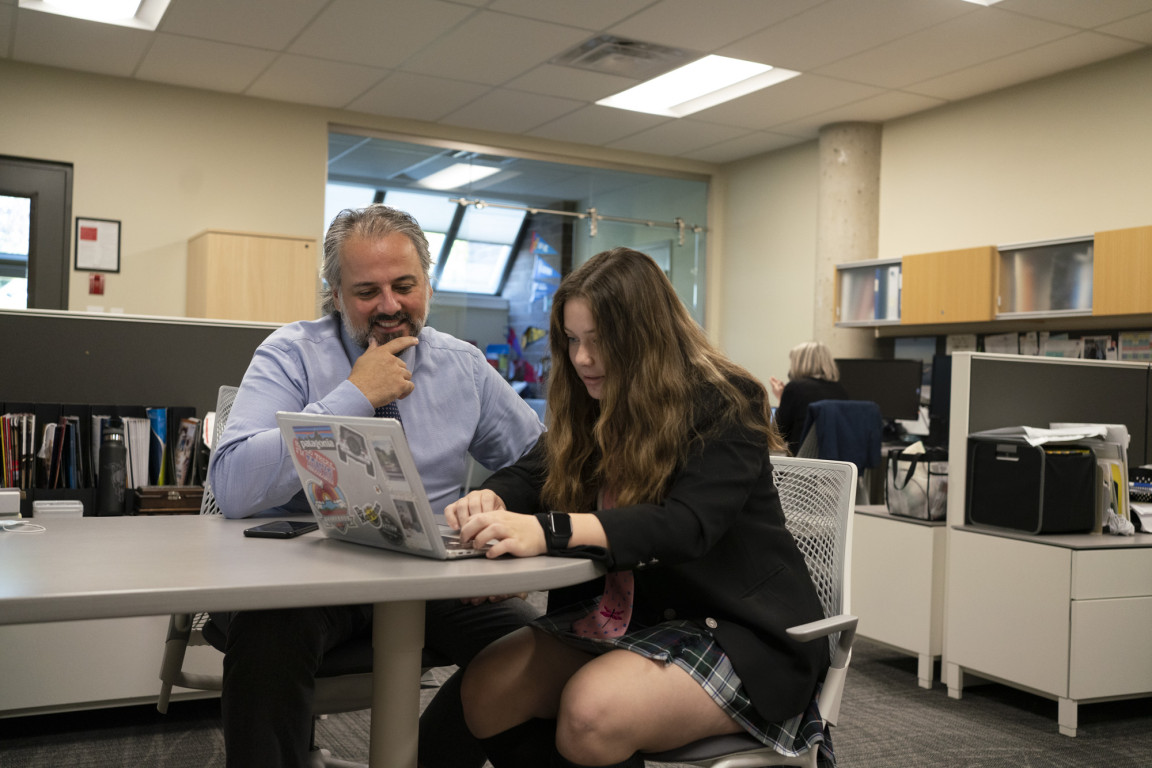
Grade 11 Academics
As Grade 10 students contemplate life in Grade 11, a common theme for them is uncertainty. Many students are uncertain about what their post-secondary plans might be. Hopefully they have developed a sense of what subjects they enjoy and know the ones in which they have experienced success. Those are the subjects that should be at the centre of a student’s academic program in Grade 11 as it will foster success and confidence as they move on into Grade 12.
A student’s academic program in Grade 11 must be made with their potential post-secondary plans in mind. Again, as there is likely to be a degree of uncertainty to those plans, keeping practical options open is the best approach. Note the key word: practical. If a student is getting 60% in Math 10 and does not particularly like the subject, for example, the choice of Pre-Calculus 11 would not be practical nor recommended! Keeping options open might seem like the right course of action but can do a disservice to a student, putting them into classes that they do not enjoy.
If students have a good sense of potential post-secondary plans, then ensuring that their Grade 11 program includes all of the required courses for admission to specific programs and/or schools is critical. Whereas universities will be looking primarily to Grade 12 courses to determine if admission requirements are met, those Grade 12 courses can have Grade 11 pre-requisites, such as in math and the sciences. Thus, it is worthwhile to also review the Grade 12 section of this website to understand the considerations involved in making those program selections.
In the end, the goal is to ensure that the Grade 11 academic courses selected maximize a student’s chances for success. As the best measure of potential success in Grade 12 is a student’s record in Grade 11, it is critical that students going into Grade 11 are given the best opportunity to succeed and meet their academic potential.
Whether you are a Returning or New Grade 11 student, it might be useful to review the presentation that Mr. Rodrigues, Director of University Counselling, gave to Grade 10 students earlier in the winter term when he covered the Course Selection process and the important considerations involved, including the Indigenous-Focused Graduation Requirement and how to fulfill that. Here is the link to the Grade 11 Course Selection Presentation Slides.
Frequently Asked Questions >
Required Courses
Brentwood’s expectation is that students in Grade 11 will take SIX (6) academic courses. The courses taken in Grade 11 are a mix of electives and those required to satisfy graduation requirement for secondary school students in British Columbia.
As part of the British Columbia graduation requirements, Brentwood students in Grade 11 are required to take:
- A Grade 11 Language Arts course
- A Grade 11 or 12 Mathematics course
- A Grade 11 or 12 Science course
- A Senior Social Studies course (although this can be completed in Grade 12)
The British Columbia Ministry of Education mandates that all students in the province need to fulfill an Indigenous-Focused Graduation Requirement (IFGR). Students can choose to fulfill the requirement in Grades 11 or 12 with Contemporary Indigenous Studies 12 (that also satisfies the senior Social Studies graduation requirement) or in Grade 12 with English First Peoples 12.
The other courses that students take as electives depend primarily on post-secondary requirements, and thus course selections must be made with post-secondary plans and admission requirements in mind.
We recognize that some students may struggle with the transition into Brentwood’s Grade 11 from Grade 10, so it is possible for a Grade 11 student to elect to take five academic courses instead with the sixth being a scheduled block in the Library Learning Commons. Students will need to discuss this when they review their course selections with University Counselling.
Elective Courses
Detailed information about courses from the teachers who know them best is offered below. It is advised that you spend some time reviewing that information before considering your choices.
While there are some Grade 12 elective courses here, not ALL of them are listed below. The ones listed are electives that we make accessible to Grade 11 students while the others tend to be for Grade 12 students only. If a Grade 11 student is keen on one of the elective courses normally reserved for Grade 12 students, they will have to make their case about accessing those electives when they discuss their Course Selections with University Counselling after spring break.
Grade 11 Course Information
Below you will find information about the courses offered at Brentwood at the Grade 11 level.
When it comes to Senior Social Studies courses, note: Brentwood does not offer Social Studies 11. Grade 11 students enrol in one of our Grade 12 level Social Studies courses, and those are listed below.
Interested in other Grade 12 Courses?
- If you are advanced in a subject and are looking to take the Grade 12 level course in that subject, or
- If you are simply curious about taking an elective course that is normally offered to Grade 12 students.
English Options
AP English 11
Students who elect to take the AP option will cover all the English 11 curriculum, most of which will be completed by March, plus write many timed, in-class synthesis, analysis, and argument papers. Students, in fact, are assessed and receive credit for both courses.
Students’ AP marks will be based on the AP-specific work she does―predominantly in the spring―in preparation for the College Board paper.
This is an accelerated environment recommended for students who were consistently proficient or extending in English 10 competencies and who are willing to read and write about unfamiliar texts under timed conditions.
Kids who struggle to meet deadlines should stay away. It requires more reading and much more critical writing than English 11, but it is also the bee’s knees and the cat’s pyjamas.
English 11
English 11 students will explore specific themes, periods, authors, or areas of the world through literary works (fiction and non-fiction) and a variety of media. Students will increase their literacy skills through close reading of appropriately challenging texts. Possible areas of focus, as they relate to written composition, include narrative, expository, descriptive, persuasive and opinion pieces. Students will engage in the planning, drafting and editing processes while writing for specific audiences and specific disciplines. This course will also emphasize how to cite sources, assess the credibility of evidence, and evaluate the quality and reliability of sources.
Math Options
Foundations of Mathematics 12
Foundations of Math 12 builds students’ understanding of graphs, probability, statistics, finance, and geometry, helping them make informed decisions about their social, financial, and intellectual lives beyond Brentwood. Many projects are based on real-world applications: figuring out how long it will take to pay off a mortgage for a dream house, investing in the stock market, and analyzing trends using real data. Students are introduced to online apps that help them with everything from managing their finances to making math-based art.
Pre-Calculus 11
Pre-Calculus 11 hones abstract algebra skills, fluency with numerical operations, proportional reasoning, and competency with functions, building a foundation for all higher mathematics. Although it emphasizes skills and vocabulary found in calculus, these skills are used in everything from science to finance. In addition to regular self-guided practice, Pre-calculus 11 emphasizes the development of communication, critical thinking, and problem-solving skills in mathematics.
Course Prerequisite: A final mark of at least 73% in Math 10 is highly recommended.
Science Options
Anatomy & Physiology 12
This course examines the biological processes that support life from the molecular to the organismal level. Students study biological molecules, metabolism, and enzymes, as well as how the body regulates its internal environment and transports materials across cell membranes. The course explores DNA replication and gene expression, the role of proteins in determining cell structure and function, and the principles of genomics and biotechnology, emphasizing the connection between microscopic processes and larger biological organization. In addition, students investigate organ systems, focusing on their structure, function, interdependence, and their role in maintaining homeostasis.
Prerequisite: Chemistry 11 completed (recommended) or concurrent is recommended
AP Biology 11
This course covers key topics that explain the structure, function, and continuity of life. Students explore biomolecules and how they form the foundation of living organisms; examine cell structures and functions, with a focus on membranes and the movement of materials across them; and study the principles of evolution and natural selection. The course also investigates DNA as the blueprint of living organisms, the stages of the cell cycle, and the mechanisms of heredity. In addition, students are introduced to biotechnology and its applications in modern science. This course is the first half of what is equivalent to a first-year university course, and so there is a large amount of content and ability to synthesize the material. Notes, readings, labs, activities, and projects are all involved with this course.
AP Chemistry 11
This course covers key topics that explain the structure, function, and continuity of life. Students explore biomolecules and how they form the foundation of living organisms; examine cell structures and functions, with a focus on membranes and the movement of materials across them; and study the principles of evolution and natural selection. The course also investigates DNA as the blueprint of living organisms, the stages of the cell cycle, and the mechanisms of heredity. In addition, students are introduced to biotechnology and its applications in modern science. This course extends beyond the topics covered in Chemistry 11 and is fast-paced, requiring some independent study.
Course Prerequisite: Proficient in Science 10 and Math 10 is highly recommended
AP Physics 11
The AP version of this course is very different from Physics 11 and explores physics concepts in greater depth and mathematical rigour. Students study kinematics, focusing on how an object’s motion can be described, analyzed, and predicted; dynamics, examining the forces involved in one-dimensional, two-dimensional, circular, and rotational motion; statics; and fluid mechanics. The course also covers work and energy, as well as momentum and impulse, providing a comprehensive foundation in advanced mechanics. This is a fast-paced, rigorous course in which students will continuously engage in problem-solving and experimental design, stretching their mathematical skills. Graphical analysis is a critical component of the work in this course. Students will write the AP Physics 1 exam in May.
Course Prerequisite: Pre-Calculus 11 completed (recommended) or concurrent is required.
Chemistry 11
Chemistry 11 examines how elements and compounds are measured, observed, quantified, and transformed. Areas of study include atoms and molecules, matter and energy, the mole, solubility and organic chemistry. The course emphasizes laboratory-based learning, where students develop skills in experimental design, laboratory techniques, data and error analysis, conceptual modelling, and scientific communication. Much of the course is analytical and conceptual, making strong mathematical reasoning a vital asset.
Course Prerequisite: Proficient in Science 10 and Math 10 is highly recommended.
Earth Sciences 11
Earth Sciences 11 provides students with an opportunity to understand the scientific principles underlying these issues and to explore sustainable ways to address them. Through project-based learning, students learn the basics of astronomy, geology, hydrology, oceanography and atmospheric sciences while gaining an understanding of Indigenous perspectives on earth systems and their connections with our solar system.
This Grade 11 science elective is designed for students who are passionate about earth and space sciences, interested in sustainability topics, comfortable learning both in and outside the classroom, independent of weather conditions, and interested in learning about First Peoples’ perspectives.
Life Sciences 11
This course provides students with an understanding of the interconnectedness of life on Earth. This course explores what defines life, how it is organized, and the unifying role of evolution. Students examine prokaryotic and eukaryotic cells and investigate how life exists in both single-celled and multicelled forms. They study the science of classification and how it has shaped our understanding of life’s remarkable diversity, while extending their exploration of microscopic environments to include bacteria, non-living viruses, and their impacts on the health of wildlife and humans. Throughout the course, students engage in an in-depth study of evolution by natural selection, including the contributions of Darwin and his contemporaries, and examine how species change over time, adapt, and become extinct. The course concludes with a focused study of ecology and the relationships among organisms and their environments.
Marine Sciences 11
Do the unknown frontiers of the deep and its ecosystems keep you up at night? Do you marvel at the majesty of the ocean’s creatures and their abilities to live and thrive in a myriad of habitats? Our Brentwood campus lies adjacent to the Pacific Ocean and this opens up incredible opportunities to explore the field of Marine Science. In this course, you will learn about the cycles and processes that sustain life and of the interplay between life and the aquatic environment in our ocean ecosystems. Through scientific inquiry, research and project-based learning, you will be involved in scientific investigations that will lead to an increased level of knowledge about marine science. This course will incorporate exercises in the lab as well as extensive field components where you’ll get hands-on experience on and perhaps in the water. We will also discuss current issues surrounding the conservation of ocean ecosystems.
Due to the extensive environmental components taught in this course, dual credits will be granted for Life Sciences 11 and Environmental Science 11 making this, by extension, a more rigorous course than Life Sciences 11 alone.
Physics 11
This course explores the fundamental principles governing motion, forces, energy, and waves. Students learn how an object’s motion can be described, analyzed, and predicted, and how forces influence changes in that motion. The course also examines energy in its various forms, emphasizing conservation and its ability to do work. In addition, students study mechanical waves and how they transfer energy through a medium without transferring matter. The different course activities will provide students with a wide variety of opportunities to learn the concepts and understand the course ideas while developing the skills required for scientific and technological inquiry, problem-solving, communicating scientific ideas and results, and working collaboratively. The approach in this course is mathematical, and students are expected to be able to solve algebraic and numerical problems comfortably.
Course Prerequisite: Proficient in Science 10 and Math 10 is highly recommended.
Social Studies Options
20th Century World History 12
This course is designed to build competencies of collaboration, communication, critical thinking and creative thinking while exploring the dominant themes of nationalism, imperialism, technological developments, and conflict in the 20th century. To enhance their understanding of global politics, students will participate in forum discussions by role-playing as delegates to represent diverse perspectives, analyze political cartoons and documents for deeper context, and deliver oral presentations on significant events, figures, and big ideas. Reading in support of the course curriculum is essential. Students must be willing to speak in class and advocate a political perspective.esearch and citing skills. Students must be willing to speak in class and advocate a political perspective.
AP Comparative Government & Politics 12
Through the lens of six countries (the United Kingdom, Nigeria, China, Russia, Iran, and Mexico), students will explore the questions of: Who has power? Why? How do they wield it? Is it democratic? How is that assessed? What structures are in place to hold or share power?. This course will help students better understand global political questions and ensure they are informed citizens of the world who can apply a critical perspective to political issues. The most important quality students can bring is a profound interest in politics and governance. Much of the course is discussion-based: seminars, current events discussions, presentations, and guest speakers. Students will write the AP Comparative Government and Politics exam in May.
AP World History 12
In AP World History: Modern, students investigate significant events, individuals, developments, and processes from 1200 to the present. Students develop and use the same skills, practices, and methods historians employ: analyzing primary and secondary sources; developing historical arguments; making historical connections; and reasoning about comparison, causation, and continuity and change over time. The course explores six themes to connect historical developments across different times and places: humans and the environment; cultural developments and interactions; governance; economic systems; social interactions and organization; and technology and innovation. Students will write the AP World History Modern exam in May.
Course Prerequisite: It is recommended, though not required, that students complete a regular senior social studies course before taking this course.
Comparative Cultures 12
Comparative Cultures 12 is a course designed to give students an understanding and knowledge of the accomplishments of past civilizations. This course will examine the beliefs, accomplishments and values of Global civilizations that have greatly influenced the world. This course explores how the diversity of a single culture deepens our understanding of others, while examining how the interplay between belief systems, social structures, and language shapes artistic expression and how geographic factors drive the evolution of agriculture, trade, and complex societies. Learning in this course occurs through group discussions, reading and analysis, and guided and self-directed inquiry projects.
Contemporary Indigenous Studies 12
This course satisfies both the Indigenous Studies and the senior Social Studies graduation requirements. This course provides students with exposure to contemporary Indigenous cultures and societies, as well as to historical, political, and social topics. As students navigate the journey toward Truth and Reconciliation, they will seek to develop a sophisticated, informed understanding of the relationship between Indigenous and non-Indigenous Canadians. This course relies on experiential learning and authentic tasks. Students will be required to participate in class discussions, read a novel, do group projects and follow current events.
Economics 12
This course explores economic theory to investigate the “economic problem,” the fundamental challenge facing all societies: how to satisfy unlimited wants and needs with limited resources. Students will learn about macro- and micro-economics, as well as the structure and operation of the Canadian economic system. From studying the profound thoughts of economists like Smith, Ricardo, and Marx, to exploring contemporary economic paradigms, this course ensures you’re well-versed in the ideas that have shaped nations.
Human Geography 12
This course explores how analyzing data from a variety of sources helps us better understand our globally connected world. Students examine how demographic and physical features, natural resources, and human activities shape patterns and population distribution, and how human activities alter landscapes in diverse ways. Through this lens, the course highlights how geographic regions can encompass a wide range of physical features and human interactions, revealing the complex relationships between people and the environments they inhabit. Learning activities will involve group discussions, reading analyses, and guided and self-directed inquiry projects.
Law Studies 12
This course gives students a broad exposure to the fundamentals of Canadian Law and ongoing opportunities to enhance and apply this knowledge in practical ways. Traditional legal subjects such as criminal law, torts, and contracts will be examined, while students also gain knowledge and insight into the importance and relevant topics of constitutional, human rights, Aboriginal, and family law. Learning how to think critically and solve problems given relevant case law is highly emphasized in this course. Both written and oral advocacy skills will be developed and assessed.
Political Studies 12
This course explores the importance of understanding how political decisions are made as a foundation for informed and engaged citizenship. It examines how political institutions and ideologies shape the exercise of power and influence political outcomes. It considers how decision-making in democratic systems of government is affected by the distribution of political and social power. This course explores international and Canadian issues, requires reading of political philosophy and current-events style texts, and requires active communication (both oral and written). The class will stimulate learning through class discussions, portfolios on political issues, examinations of global political issues, analyses of political philosophies, MUN-style simulations, and political speech analysis and presentations.
Social Justice 12
This course focuses on the interconnected nature of social justice issues and explores how individual worldviews shape and inform our understanding of them. Students examine the complex causes of social injustice and their lasting impacts on society, and consider how social justice initiatives can bring about meaningful change for individuals and systems. Through investigations into and reflections on intersectionality, privilege and power, LGBTQ2 issues, Indigenous awareness, and gender equality, to name a few, students will be challenged to step outside their comfort zone and work in their stretch or risk zones. Thus, students must be open to challenging their current mindset to adopt a growth mindset.
Urban & Sustainability Studies 12
This course explores the dynamic relationship among urbanization, society, and sustainability. Students will examine how urban spaces are shaped by geographic, economic, political, and social forces, and how decision-making in urban planning can create more sustainable futures. Focusing on the question: How can society and physical spaces be adapted to create a better world?, students are asked to think critically and collaboratively about local, national, and international examples of urban design, both past and present. Students will analyze the impact of government policies, urban planning decisions, and innovative sustainability approaches through project-based learning.
Language Options
French 11
This course targets all areas of language competency—reading, writing, speaking, and listening—using an acquisition-based approach. The emphasis is on acquiring language naturally rather than through isolated grammar drills or vocabulary lists. Students will have many opportunities to build on and extend their existing language skills through novel studies, cultural explorations, personal and formal writing, interactive games, and dictées. French is used as the primary language of interaction and instruction throughout the course.
Course Prerequisite: French 10 or its equivalent
Mandarin 11
Mandarin 11 builds upon the knowledge and skills acquired in previous years. It aims to help students build confidence, communication and trust in an interactive and immersive Mandarin environment. The course covers all areas of language competency: listening, speaking, reading, and writing. Language acquisition is fostered through storytelling and engaging classroom discussions. Students will have opportunities to share about their daily lives at school and home, as well as their plans for the future. Cultural exploration is an integral part of the course. Activities include making bubble tea, crafting mooncakes for the Moon Festival, writing Spring Couplets, traditional paper-cutting, and participating in a field trip to Victoria’s Chinatown for Lunar New Year.
Course Prerequisite: Mandarin 10 or its equivalent. Students should have completed at least 2 years of Mandarin studies.
Spanish 11
This course explores the connection between language and culture while providing the opportunity to improve all language skills in a very interactive way. Students develop their skills in reading and listening comprehension, as well as in (creative) writing and oral communication. Students learn through interactive stories and novels that include all the basic grammatical structures necessary to become capable communicators. At the same time, a greater emphasis is placed on Hispanic cultures from around the world.
Course Prerequisite: Spanish 10 or equivalent
Elective Options
Advanced Design 12
This course expands on the design principles that students may have been introduced to in earlier studies. It will elevate students’ learning from “making” to “thinking”, moving beyond how to make things into why things are made, who they are for, what impact they have, and how design shapes behaviour and society. This course will be a rigorous, intellectual course, not just a hands-on elective. It will prepare students to think critically, create responsibly, and navigate complex real-world problems—competencies that align strongly with our school’s goals and 21st-century learning outcomes.
Students will produce portfolio-quality work while developing professional habits such as project management, documentation, and constructive response to feedback. Equally important, the course emphasizes responsible and sustainable making, encouraging students to consider environmental impact, accessibility, and ethical design decisions.
Course Prerequisite: It is recommended that students have taken a design-based course prior to taking this course.
AP Computer Science A 12
AP Computer Science A is an in-depth study of the Java computer language. The students will learn the basics of object-oriented programming and build a foundation in programming that will prepare them for any post-secondary discipline. Units of study include: control structures; classes and objects; interfaces; arrays; array lists; inheritance and classes; streams and files; recursion; binary search tree, analysis of algorithms and sorting methods. Designed to provide practical coding and problem-solving skills, the course serves as a foundation for future studies or careers in computer science and computer engineering. Prior coding experience is highly recommended. Students will write the AP Computer Science A exam in May.
AP Computer Science Principles 12
AP Computer Science Principles is an entry-level course that introduces students to the foundations of modern computing. The curriculum does not assume prior knowledge of computing concepts, though knowledge of introductory algebra is assumed. The course covers a broad range of foundational topics, including programming, algorithms, the Internet, big data, digital privacy and security, and the societal impacts of computing. Major units of study include: digital information, the internet, introduction to algorithms and programming, big data: research and privacy, building apps, and creating and exploring tasks. Students will complete two in-class performance tasks and write the AP Computer Science Principles exam in May.
AP Macroeconomics 12
This college-level course introduces students to the principles that apply to an economic system as a whole. The course places particular emphasis on the study of national income and price-level determination. It also develops students’ familiarity with economic performance measures, the financial sector, stabilization policies, economic growth, and international economics. Students learn to use graphs, charts, and data to analyze, describe, and explain economic concepts. Students will explore concepts such as GDP, inflation, interest rates, unemployment rates, fiscal and monetary policies, foreign exchange and bonds, and, most importantly, how these factors impact everyday life. Students will write the AP Macroeconomics exam in May.
AP Microeconomics 12
AP Microeconomics is a college-level course that introduces students to the principles of economics that apply to the functions of individual economic decision-makers. The course also develops students’ familiarity with the operation of product and factor markets, distributions of income, market failure, and the role of government in promoting greater efficiency and equity in the economy. Students learn to use graphs, charts, and data to analyze, describe, and explain economic concepts. Students will write the AP Microeconomics exam in May.
AP Research 12
This course prepares students to conduct original research in any discipline at the university level. Students design, plan, and implement a year-long investigation to address a research question. Through this inquiry, they further the skills they acquired in the AP Seminar course by learning research methodology, employing ethical research practices, and accessing, analyzing, and synthesizing information. The course culminates in an academic paper of 4,000–5,000 words (accompanied by a performance, exhibit, or product where applicable) and a presentation with an oral defence.
Course Prerequisite: AP Seminar 11 with at least an AP score of 3.
AP Seminar 11
This course is aimed at building and refining high-level reading, thinking, discussion and research skills. It explores contemporary issues and provides students with a framework for pursuing academically rigorous research in an area of personal interest. Students will explore their chosen themes through collaborative discussions and in-depth research papers, building a foundation for critical analysis. They will further refine their communication skills by mastering persuasive writing and practicing public speaking. This course is best suited for students with solid foundations in close reading and scholarly writing who want to lean into big research projects and who are passionate about exploring real-world issues across all subjects. Students will write the AP Seminar exam in May.
AP Studio Art 11
This course presents students with the challenge of researching, defining, producing, assessing, refining and reflecting a body of work in the fields of art and/or design.
This course is studio-based, with time spent in active, self-guided studio work during both the academic (morning) class time and an art afternoon commitment (beyond regular Brentwood Arts requirements). Instruction consists of broadly defined assignments, individual coaching, and guided group critique. Additional instruction is occasionally provided to provide exemplars from the worlds of art and design, outline technical issues related to art-making or curatorial practice, or to discuss post-secondary paths and career opportunities related to art and design.
AP Studio Art 12 has a final AP exam that takes the form of an adjudicated portfolio submission. Students are not required to make the submission while in AP Studio Art 11; those students are typically on track to spend a second year in AP Studio Art 12 in Grade 12 and submit that portfolio then. If students start in Grade 11 in this course, they should note that Ministry credit is only awarded at the end of their second year in the course with the completion of the AP portfolio submission.
Students should only take this class if they are passionate about making, feel comfortable in a studio environment and are capable of self-directed, inquiry-based learning. Students should be prepared to find time in their schedules for several hours per week of independent studio work above and beyond the time commitments already listed. It will be very challenging to find success in this course without a strong routine.
Course Prerequisite: Application, portfolio submission, and interview with course instructor, Ms. Andersen.
Beginner French
This course will offer students who did not begin Core French in the elementary grades the opportunity to pursue French at the secondary level. It is a course for beginners, designed for anyone with no French knowledge who wants to learn. The proficiencies acquired through the study of French at this level will equip learners with the communication skills to take French 11. This is an intensive course designed to cover essential learning standards from Grades 5 to 10 in an accelerated timeframe, preparing students for French 11.
Beginner Mandarin
This course covers all language competencies: listening, speaking, reading, and writing. Students will develop these skills by immersing themselves in a Mandarin-rich classroom environment supported by visual aids such as posters, signs, and gestures. Language acquisition is fostered through storytelling and engaging classroom discussions. Cultural exploration is an integral part of the course. Activities include making bubble tea, crafting mooncakes for the Moon Festival, writing Spring Couplets, traditional paper-cutting, and participating in a field trip to Victoria’s Chinatown for Lunar New Year.
Beginner Spanish
This course will offer students who did not begin Spanish studies in previous grades the opportunity to pursue them at the secondary level. It is a course for beginners, designed for anyone with limited or no Spanish knowledge who wants to learn. The proficiencies acquired through the study of Spanish at this level will equip learners with the communication skills to take Spanish 11. This is an intensive course designed to cover essential learning standards from Grades 5 to 10 in an accelerated timeframe, preparing students for Spanish 11.
Coding 11: Python
Programming is a powerful tool for applying computational thinking. Because problem-solving is inherently creative, many challenges can be addressed through coding applications. Classroom activities are project-based and centred on problem-solving, combining online learning to build foundational language skills with larger coding challenges that encourage hands-on learning. This course is well-suited to students who enjoy problem-solving and have strong math skills, as well as those with curious minds who like working both independently and collaboratively. It is designed specifically for beginners who are new to coding.
Entrepreneurship 12
This course will allow the students to become fully immersed in both the theory and practical aspects of entrepreneurship. Along with a large amount of theory covered during the year, the students will face the challenge of proposing, developing, and running a small business for a brief period. Later in the year, students will be required to develop a much larger and more complex business venture and implement it during the annual Brentwood Regatta in April. All participants will experience both the positive and negative aspects of cooperative and competitive teamwork. Those students who are not comfortable working in teams or competing with others will really have to stretch themselves out of their comfort zones to succeed in this course.
Please note: The BC Ministry of Education labels this course as an Applied Skill; this means it is not considered an acceptable course for admission purposes at many Canadian universities. Talk to University Counselling for more information.
Financial Accounting 12
In this course, students will master basic accounting principles and cycles while learning to implement effective internal control systems for business management. They will also gain the skills to evaluate a company’s financial health through statement analysis and develop a functional understanding of stock market terminology and activity. There is a heavy emphasis on learning through case studies. Students will initially focus on understanding and building financial statements. As the year progresses, a larger emphasis will be placed on analysis and critical thinking. Strong math and organizational skills will be assets.
Please note: The BC Ministry of Education labels this course as an Applied Skill; this means it is not considered an acceptable course for admission purposes at many Canadian universities. Talk to University Counselling for more information.
Statistics 12
Statistics 12 is a course designed to develop students’ mathematical understanding of the tools used to collect, analyze, and interpret data. Students will explore topics such as variation and distribution, probability and uncertainty, and how data drives decision-making and policy creation. The course emphasizes critical thinking, as students will analyze real-world data, connect mathematics to real-world contexts, and tackle projects that require critical analysis and creativity. This course is intended for students considering post-secondary programs in STEM or data-driven fields such as the social sciences, politics, or business.
Frequently Asked Questions
HOW MANY ACADEMIC COURSES MUST I TAKE?
Grade 11 students are expected to take SIX academic courses in the academic morning timetable.
We recognize that some students may struggle with the transition into Brentwood’s Grade 11 from Grade 10, so it is possible for a Grade 11 student to elect to take five academic courses instead with the sixth being a scheduled block in the Library Learning Commons. Students will need to discuss this when they review their course selections with University Counselling.
WHAT COURSES ARE REQUIRED?
The courses that are required within Grade 11 program are:
- a Language Arts 11,
- a Grade 11 or 12 Mathematics course,
- a Grade 11 or 12 Science course,
- and a senior Social Studies course.
These are required for graduation here in British Columbia. The courses that Brentwood offers to Grade 11 students that satisfy these general requirements are made clear on the Grade 11 Courses page.
When it comes to the senior Social Studies course, as we do not offer Social Studies 11 and the senior Social Studies courses are taken by a mix of Grade 11 and 12 students, a Grade 11 student can delay taking one until Grade 12. This might be an option worth exercising if students are finding it difficult to fit in all of the courses they want to take in Grade 11.
A course that fulfills the new Indigenous Studies graduation requirement also needs to be taken in either Grade 11 or 12. Contemporary Indigenous Studies 12 fulfills this requirement while simultaneously fulfilling the senior Social Studies requirement. Student may plan, instead, to take English First Peoples 12 in Grade 12 to fulfill their Indigenous Studies graduation requirement and their required Language Arts 12 course.
WHAT COURSES SATISFY THE SENIOR SOCIAL STUDIES REQUIREMENT?
The courses that satisfy the Ministry of Education’s requirement as “Senior Social Studies” that Brentwood offers include:
- 20th Century World History 12
- AP Comparative Government & Politics 12
- AP United States History 12
- AP World History 12
- Comparative Cultures 12
- Contemporary Indigenous Studies 12
- Economics 12
- Human Geography 12
- Law Studies 12
- Philosophy, Politics & Economics 12
- Political Studies 12
- Social Justice 12
- Urban & Sustainability Studies 12
The following courses that are offered by the Social Studies department do NOT satisfy the Ministry of Education’s requirement of a Senior Social Studies:
- Entrepreneurship 12
- Financial Accounting 12
- AP Macroeconomics 12
- AP Microeconomics 12
- AP Psychology 12
- AP Research 12
- AP Seminar 11
Again, when it comes to the senior Social Studies course, as we do not offer Social Studies 11 and the senior Social Studies courses are taken by a mix of Grade 11 and 12 students, a Grade 11 student can delay taking one to Grade 12. This might be an option worth exercising if students are finding it difficult to fit in all of the courses they want to take in Grade 11.
DO I NEED A LANGUAGE 11?
A Language 11 is not required for graduation from a high school in British Columbia; however, Brentwood believes strongly that students should study a second language as part of their secondary education. So even when students have limited or no second-language background, Brentwood offers beginner’s level courses in French, Mandarin, and Spanish.
Perhaps more importantly, completing a Language 11 course is an admission requirement at some universities. Most universities in the United States recommends that applicants have completed three years (Grades 9-11) of a second language, and sometimes even four years.
WHICH MATH COURSE SHOULD I TAKE?
Pre-Calculus 11 or Foundations of Mathematics 12? It depends on your post-secondary plans. One course it is not necessarily easier than the other, but they do have different approaches and different purposes.
- If you think you will want to study anything related to Science, Engineering or Commerce, Pre-Calculus 11 is a must because you will need Pre-Calculus 12 in Grade 12 in order to do Calculus for these fields.
- If you plan on studying something that will not require university-level Calculus, such as Arts, Humanities, or Social Sciences, then Foundations of Mathematics 12 or Statistics 12 might be the better option.
UBC complicates things: they require ALL applicants from BC to have either Pre-Calculus 11 or Foundations of Mathematics 12. That is why we offer the Grade 12 level of the course instead of 11 because those students who take it are typically not looking to do two more years of math after they finish Grade 10 math.
For students who take Foundations of Mathematics 12 in Grade 11, it usually the last math course they take. It is NOT possible to go from Foundations of Mathematics 12 to Pre-Calculus 12 in Grade 12; Pre-Calculus 11 is pre-requisite for Pre-Calculus 12 and Foundations of Mathematics 12 is NOT equivalent to Pre-Calculus 11.
If this makes you think, “I should take Pre-Calculus 11 to keep my options open,” we advise considerable caution! Do NOT take Pre-Calculus 11 if you cannot get a B (73%) in Math 10.
WHAT ELECTIVE COURSES SHOULD I TAKE IF I DON’T KNOW WHAT I WANT TO DO?
Take what you enjoy; if you enjoy a subject, you will very likely do well in it.
Some people might advise you to “keep your options open.” That is NOT always the best advice. You need to ensure that the options you keep open are practical ones for you. For example, taking Pre-Calculus 11 when you can only manage a C in Math 10 is a terrible idea!
WHAT DOES “KEEPING MY OPTIONS OPEN” ACTUALLY MEAN?
Generally speaking, programs that have very specific admission requirements are in the Sciences, Engineering, and Commerce. They always require English Studies 12, plus…
- Life/Health/Medical Science programs typically require students to have as many Grade 11 and Grade 12 Science course as possible, but normally focus on biology and chemistry. They also require Pre-Calculus 12 and very often Calculus 12.
- Physical Science programs typically require students to have as many Grade 11 and Grade 12 Science course as possible, but normally focus on chemistry and physics. They also require Pre-Calculus 12 and very often Calculus 12.
- Engineering programs requires Physics 12, Chemistry 12, Pre-Calculus 12 and Calculus 12.
- Commerce programs requires Pre-Calculus 12 and often Calculus 12.
The only specific requirement for a Bachelor of Arts degree is English Studies 12. So, essentially, “keeping your options open” means keeping options open THAT REQUIRE HIGH LEVEL SCIENCE AND MATHEMATICS COURSES. Ask yourself the question: do you really love science and math… especially the really hard courses in science and math?
You must be cautious of this approach, though: you do not want to keep options open that are not practical for you.
DO I NEED A LANGUAGE 12?
There are no universities that generally require a Language 12 credit for admission.
Some Bachelor of Arts degree programs, like that at UBC, include a second language requirement. At UBC, that requirement can be satisfied with a Language 12 credit!
IS THERE AN ADVANTAGE TO TAKING AN AP COURSE?
AP stands for Advanced Placement. AP Courses are those administered by the CollegeBoard and are supposed to be equivalent to first-year university courses. Success is measured by exams that are taken in May. Rather than percent marks, the exams are graded on a five-point scale: 5 being the best and 1 the worst. A score of 4 or 5 may get you credit for the equivalent first year university course at most schools in North America. Often at very selective schools in the UK and elsewhere in the world, AP exam results would be required to be eligible for admission.
In all AP courses where there is an exam, taking the AP exam is mandatory.
The majority of AP courses are offered to Grade 12 students, but keen and talented Grade 11 students may be allowed to enrol.
There are a set of courses focused on Grade 11 students: AP Biology 11, AP Chemistry 11, AP English 11, AP Physics 11, and AP Seminar 11. Only in AP English 11, AP Physics 11, and AP Seminar 11 are AP exams written in May. The other two courses can be thought of as “Pre-AP” courses in that they must be taken to enrol in AP Biology 12 and AP Chemistry 12 in which AP exams are written in May. In the case of these Grade 11 AP courses, students who complete courses gain the following British Columbia Ministry of Education credits:
- Life Science 11 (LFSC 11) for students in AP Biology 11;
- Chemistry 11 (CH 11) for students in AP Chemistry 11;
- AP Physics 1 Honours 11 (APPHH 11) for students in AP Physics 11;
- AP Capstone Seminar 11 (APCS 11) for students in AP Seminar 11;
- Literary Studies 11 (LTST 11) PLUS AP English Language & Composition 12 (APEN 12) for students in AP English 11.
Reasons to take an AP course:
- You are genuinely interested in deeper study of the subject.
- You are seeking more rigour in the subject.
- You may need the AP course to satisfy certain university admission requirements.
- Success on the AP exam may allow you to gain university course credit.
There is a myth out there that says that if you are applying to universities in the US, you need APs. You need to challenge yourself to a reasonable degree, and a way to do that is with AP courses. They are not, however, required.
The other side of that myth is that if you are applying to universities in Canada, you do not need APs. There are Canadian universities that consider the AP courses for admission and scholarship purposes, such as UBC, Toronto, and Waterloo. Regardless, if you are deeply interested in the subject, an AP course will likely give you a much richer experience and better preparation for further study in that subject.
When it comes to AP courses, the School approaches them with this mindset: students should not feel like they are being penalized for taking an AP course over a regular course.
AM I A SUITABLE CANDIDATE FOR TAKING AN AP COURSE?
Probably the best person to ask would be your teacher in the Grade 10 version of the subject you are considering. For example, ask your Science 10 teacher if you are considering the AP versions in biology, chemistry, and/or physics. You can also ask your Advisor.
AFTER I’VE SELECTED MY COURSES, CAN I CHANGE MY MIND?
Yes.
After you select during the winter midterm, you will have until spring break to go into the Course Registration Form and change your selections. After spring break and through the spring term, you will need to connect with University Counselling to make changes.
New Students, you do this by contacting Mr. Rodrigues. He will be reaching out to you after you make your initial selections.
Returning Students, you will need to review and discuss your course selection in University Counselling regardless, but see your University Counsellor again to make a change if, after reflecting on things, you believe it is warranted.
HOW LATE CAN I CHANGE MY MIND ABOUT MY COURSES
We build the Academic Timetable early in the summer based on your selections, so changes are best made before the summer.
Returning Students, when you receive your final Report Card of the year, there will be the opportunity to contact University Counselling with any changes that you need to make based on final results and/or recommendation made by them. In fact, we will be expecting you to make any desired changes by July 15.
Inevitably, there are students who want or need to make changes to their courses in September. You can make changes, as long as the planned change works in your timetable and there is room available in the intended courses.
We require that you make any changes by Thanksgiving of the fall term.
SHOULD I WORRY ABOUT GETTING ENOUGH CREDITS TO GRADUATE?
No. Numbers of credits is not a problem for Brentwood students who attend for at least two years. For other students, records are reviewed thoroughly to identify any specific missing credits.
CAN I TAKE A COURSE ON-LINE?
Yes, it is possible for a student to complete a course over the summer before Grade 11 via Distance Learning, if students feel that it would be in their best interest.
There are definitely advantages to being able to take a course by Distance Learning, particularly if students are interested in taking more courses than are possible in the Brentwood academic timetable. At the same time, there are instances in which a Distance Learning course would not be advised.
Courses completed by Distance Learning tend to do a poor job at preparing students for further study in that subject, thus we DO NOT recommend taking a course by Distance Learning in a subject in which you intend to further courses. For example, we do NOT recommend students take a math course by Distance Learning if they want to take further math. We recommend that you consider a Distance Learning course in a terminal subject, in other words, in a subject where you will not be pursuing further studies.
Generally speaking, we DO NOT recommend that students take a course by Distance Learning, particularly if the course is offered at Brentwood. Taking a course by Distance Learning would require careful discussion with the University Counselling team and, potentially, the approval of the Deputy Head, Academics.
WHAT IF I DON’T KNOW WHAT I WANT TO STUDY AT UNIVERSITY?
It is not unusual for students at your age to be uncertain about what they want to study. (In the US, for example, nearly 75% of students change their Major area of focus over the course of their undergraduate degree.)
The key for those who are uncertain at this time is to consider your interests and abilities. What are the courses that I enjoy? What are the courses that I do well in? Normally the answers are the same for both questions, so the selection of courses is typically straightforward.
But remember, for Grade 11 you are only selecting a small number of elective courses, so the choices you have to make are not too complex. And if you think you get it wrong in Grade 11, there is still time in Grade 12 to re-focus your course planning.
HOW DO I FIND OUT WHAT COURSES I NEED FOR MY CHOICE OF UNIVERSITY/PROGRAM?
Check the Admission Requirements pages of university websites. If the information is unclear to you, then ask your University Counsellor as they are an expert on that question!
You can also use the great tools that available through your MyBlueprint account.
ARE THERE COURSES THAT DON’T COUNT FOR UNIVERSITY ADMISSION?
This depends on the university and the program. Some generalizations are that Entrepreneurship 12 and Financial Accounting 12 typically do not count as they are not considered to be Academic courses (foolishly, we believe) at schools such as University of Victoria.
There are many cases, however, when all courses that you take, including fine arts courses, are considered or can be used to satisfy admission requirements. It is best to get clarity on this by talking to your University Counsellor.
US universities will look at ALL of your courses from Grade 9 to Grade 12.
Start Academic Course Selection
Course selections are collected using Google Forms. Please log in with your Brentwood Google Account (user.name@brentwood.ca) to being Academic Course Selection.
Start Academic Course Selection
Course selections are collected using Google Forms. Please log in with your Brentwood Google Account (user.name@brentwood.ca) to being Academic Course Selection.


Where Students Choose To Be
+1 (250) 743-5521
admissions@brentwood.ca
info@brentwood.ca
2735 Mount Baker Road
Mill Bay, BC, Canada V8H 1K8